Spanish Conversation Practice: 6 Methods and a Weekly Plan
The best Spanish conversation practice is a mix: a few minutes of solo speaking every day (shadowing, talking to yourself, recording yourself) and two or three real conversations a week, with a person or an AI tutor that corrects you. Solo work builds speed; conversations teach you to answer what you didn't expect. Below are six methods, what each one costs, and a week that combines them in about 20 minutes a day.
- Six methods side by side: whether you need another person, what it costs, what feedback you get on your mistakes and what each is best for.
- A paid tutor gives the most expert feedback, a language exchange gives you real people for free, and an AI tutor gives daily practice without scheduling or nerves.
Most learners can read far more Spanish than they can say, because courses give them so little time to speak. The linguist Merrill Swain argued that producing language is what makes learners "notice what they do not know or know only partially": you only find out you can't say I would have gone when you try to say it. Every method below is a way to get more of those moments.
Start here, no download needed. Find your level with our free Spanish level test, about 8 minutes in your browser. Then grab a dialogue at that level from our 12 Spanish conversation examples to use as material this week.
Six ways to practice speaking Spanish, compared
| Method | Needs another person? | Money | Feedback on mistakes | Best for |
|---|---|---|---|---|
| Shadowing | No | Free | None, you compare by ear | Accent, rhythm, listening speed |
| Talking to yourself | No | Free | None | Finding the words you lack |
| Recording yourself | No | Free | Only what you catch on replay | Hearing your own habits |
| Language exchange | Yes | Free or freemium apps | Some, from a non-teacher | Real people, real pace |
| Paid tutor | Yes | Hourly, set by the tutor | Expert and personal | Accent and stubborn errors |
| AI conversation | No | Free tiers or subscription | Every turn, instantly | Daily volume without nerves |
1. Shadowing: copy a native speaker in real time
Play a short clip of Spanish, a minute or less, and speak along with it a split second behind, matching the speed and the melody. Start with audio you already understand, because your attention should go to the sounds, not the meaning. The applied linguist Yo Hamada, who has published on the technique for years, reports a noticeable change from two 10 to 15 minute sessions a week for a month, and suggests moving to a new clip after five or six run-throughs.
Pros: Fast, free, and good for rhythm and accent. Cons: It's repetition, not conversation. You never choose a word yourself, so it won't fix freezing.
Our practice-without-a-partner guide walks through the full shadowing steps.
2. Talking to yourself: narrate your day in Spanish
Describe what you're doing as you do it: Estoy haciendo la cena. Me falta cebolla. Mañana tengo que llamar a mi madre. Do it in the shower, on a walk, while cooking. When you hit a word you don't know, say it another way, then look it up afterward and write it down.
Pros: It costs nothing, it fits into dead time, and it shows you exactly which everyday words you lack. Cons: Nobody corrects you, so mistakes can set in. You also never practice understanding a reply.
3. Recording yourself: hear what others hear
Set a timer for two minutes and answer one question out loud, recording on your phone: ¿Qué hiciste el fin de semana? Listen back once. Note the words you repeated, where you stalled and which sounds you'd like to fix. Keep the first recording and make a new one on the same question a month later.
Pros: The most honest mirror you have, and the month-apart pair lets you hear your progress. Cons: Most people hate hearing their own voice, and you'll only catch the mistakes you already know are mistakes.
4. Language exchange: trade your English for their Spanish
Apps like Tandem and HelloTalk match you with Spanish speakers who want to practice English, by text, voice message or call. Both are free to start; Tandem sells a Pro upgrade. In many cities you'll also find in-person intercambios in bars and cafés.
Pros: Real people, real speed, and you'll hear Spanish from Spain, Mexico, Argentina and beyond. Cons: Half the time is in English, your partner isn't a teacher, and scheduling across time zones takes work. If one partner drops out, your week falls apart, so line up two rather than one.
5. Paid tutor: the most expert feedback
Platforms like italki and Preply list thousands of Spanish tutors, and each tutor sets their own hourly rate. A good tutor hears the error you make every time and gives you a drill for it, something no other method here does as well.
Pros: Personal, expert feedback, especially on pronunciation, and a fixed appointment keeps you showing up. Cons: The cost adds up fast if you want speaking practice several times a week, and some learners stay too nervous with a stranger to say much in the first lessons.
6. AI conversation: daily practice that answers back
An AI tutor talks with you whenever you open the app, by voice or text, and corrects you as you go. It fills the gap between solo drills, where nobody answers, and lessons, which are expensive to have every day.
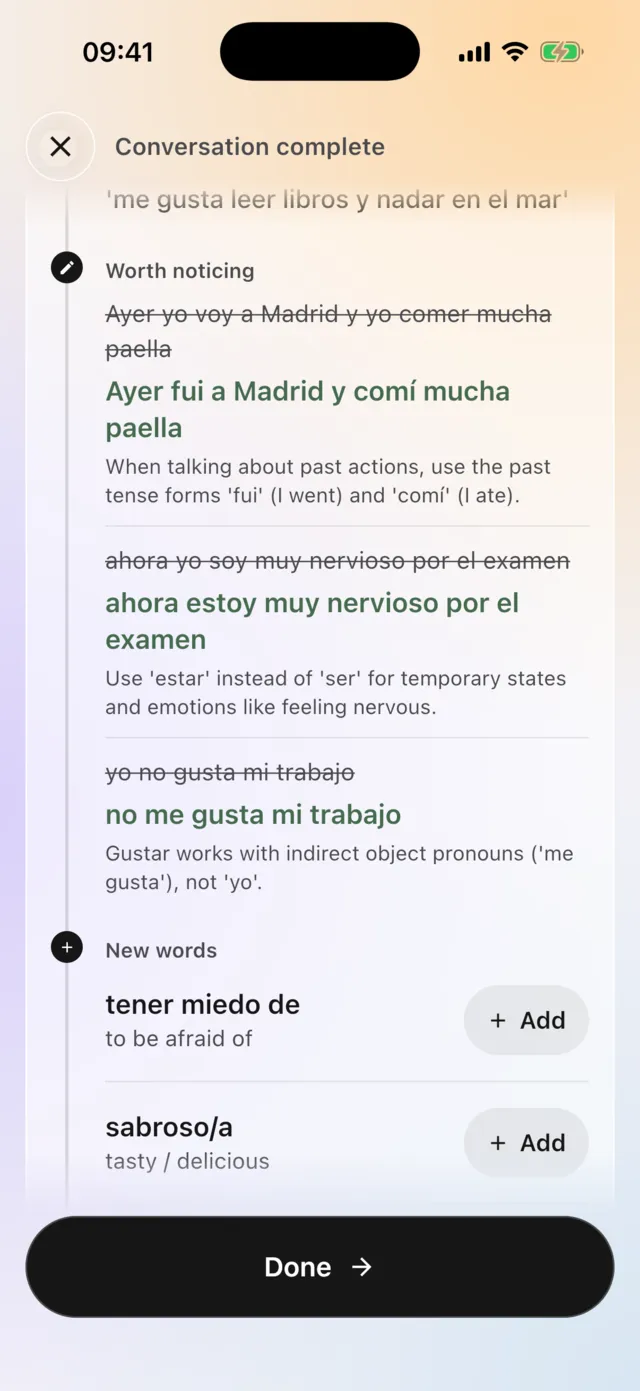
We make Fuego, so here's how ours works. You hold a button and speak, let go and hear the reply, or type. The tutor picks the topic, keeps the conversation moving and shows you the corrected sentence with a one-line reason. For Spanish it speaks the Spanish of Spain and leaves your Latin American forms alone. A sample of the shape, written by us:
You: El sábado iba al cine con mis amigos, pero la película era muy aburrida.
Fuego: ¡Vaya, qué pena de plan! ¿Y qué película era? Cuéntame, ¿por qué te aburrió tanto?
Better: El sábado fui al cine con mis amigos.
One finished trip takes the preterite, fui; iba describes a habit or a background.
After each conversation, a recap lists the words worth keeping and your corrections, and the words you struggled with shape your next flashcards. You can replay any reply at a slower speed, and choose from three voice speeds.
Pros: Unlimited patience, no scheduling, and you can practice at whatever moment you have. Cons: It's not a person: it won't prepare you for a stranger's accent or a crowded bar, an AI can occasionally get a correction wrong, and it isn't exam prep. Fuego needs a connection, runs on iPhone, iPad and Android, and is a subscription app: your first conversation with the tutor is free, and words, flashcards, reading, listening and the daily plan stay free.
A weekly Spanish speaking plan
About 20 minutes a day, built so every day has some speaking and each week has at least two conversations that answer back. Swap the conversation days for a tutor or exchange when you have one.
| Day | Solo warm-up (5 min) | Main practice (15 min) |
|---|---|---|
| Monday | Shadow one clip | Read a dialogue aloud, then say it from the English |
| Tuesday | Narrate your morning | Conversation: AI tutor or exchange partner |
| Wednesday | Shadow the same clip | Record a 2-minute answer, listen back once |
| Thursday | Narrate your commute | Conversation: AI tutor or exchange partner |
| Friday | Shadow a new clip | Retell the week's dialogue with three details changed |
| Saturday | Rest or listen only | Longer conversation or a paid lesson, 30 to 60 min |
| Sunday | Rest | Write down the five corrections that came up most |
Two rules make the plan work. Repeat material across the week instead of starting fresh each day, and spend the last minute of every conversation day saying your corrected sentences out loud once.
How do you know your speaking is improving?
Listen to the first and last recording of the month side by side. Three things should have changed: fewer long pauses, fewer filler sounds like eh and pues, and longer answers before you run out of words. If the recordings sound the same after a month, the plan has too much input and too little speaking, so swap a shadowing day for a conversation day.
What level do you need to start conversation practice?
You can start at A1, as long as the conversation is built for your level. A beginner can manage ¿De dónde eres? ¿A qué te dedicas? exchanges in the first weeks, and our A1 conversation examples give you the lines. What changes with level is the mix: at A1 and A2, lean on shadowing and dialogues; from B1, spend more of the week in free conversation. Pair it with a list of common words, like our free 1,000 common Spanish words with audio, so you have something to say from day one.
Frequently asked questions
How can I practice speaking Spanish every day?
Tie it to something you already do. Shadow a clip while the coffee brews, narrate your commute, or have a ten-minute conversation with an AI tutor at lunch. Twenty minutes split into two blocks is easier to keep than one hour on Sunday, and the weekly plan above fits that shape.
Where can I practice Spanish conversation online?
Language exchange apps such as Tandem and HelloTalk connect you with native speakers for free. Tutor marketplaces like italki and Preply sell one-on-one lessons by the hour. AI tutor apps, Fuego among them, give you a conversation partner any time, by voice or text.
Is a language exchange or a paid tutor better?
A tutor gives better feedback; an exchange gives more variety for less money. If your budget allows one lesson a week, take it and fill the other days with exchanges or an AI tutor. If you're nervous, an AI tutor is a gentler start before either.
How long until I can hold a conversation in Spanish?
It depends on your starting point and how much you speak. The US Foreign Service Institute puts Spanish in its easiest group for English speakers, at about 552 to 690 class hours for professional working proficiency. Simple everyday exchanges come much earlier than that: at A1 you can already handle short conversations like the ones in our A1 dialogues.
Can I learn Spanish conversation without living in Spain?
Yes. Online exchanges, tutors and AI tutors give you real conversation from anywhere. If Spain is where you'll use it, choose material in Spain's Spanish, with vosotros and its everyday words, which is what our dialogues and Fuego's tutor use.
Is talking to an AI enough to become fluent?
No. AI conversation gives you volume, the hundreds of small exchanges that build speed, but you still need to understand real people at real speed. Use AI for daily practice, and add real conversations, listening and reading as you can.
Sources checked October 6, 2026
- Merrill Swain's output hypothesis, quoting Swain (1995): The Language Teacher (JALT), "Output and beyond to dialogue: a review of Merrill Swain's current approach to SLA"
- Yo Hamada, "Shadowing for language teaching", TESL Ontario CONTACT Magazine, August 2018 (citing Hamada 2016 and Shiki et al. 2010)
- Tandem: homepage and FAQ (free, with Tandem Pro); HelloTalk: homepage
- italki: Spanish teachers; Preply: Spanish tutors ("Our tutors set their own rates")
- US Department of State, Foreign Service Institute: foreign language training
- Pages read for the field: Preply, 9 easy ways to get real Spanish conversation practice, Busuu, Spanish conversations
- Fuego: the app as it stood on October 6, 2026
Related guides
- 1,000 common Spanish words, Spanish level test, Learn Spanish with Fuego
- Best Duolingo Alternatives in 2026: 8 Apps Compared
- Babbel vs Duolingo (2026): Which Language App to Pick
- Speak with an AI Language Tutor: 7 Apps Compared (2026)
- Learn Spanish with AI: 6 Apps and a Daily Routine (2026)
- How Long Does It Take to Learn Spanish? Hours by Level
- Does Duolingo Work? What the Research Says (2026)
- Spanish Conversation Examples: 12 Dialogues, A1 to B2
- How to Practice Speaking a Language Without a Partner
- Fuego vs Praktika: Daily Review or Avatar Tutors?
- Fuego vs Speak: A Daily Plan or a Spoken Course?
- Fuego vs Langua: Daily Activities or Flexible Calls?
- Fuego vs Talkpal: Daily Review or More Language Choice?
- Fuego vs Pingo AI: Conversation and What Comes After
- Praktika Alternatives: Choose by Your Learning Goal
- Duolingo Max Alternatives for Conversation Practice
- Best App to Learn Polish: Choose by Your Study Goal