Your private Spanish tutor, by voice or by text. Learn Spanish by actually speaking it.
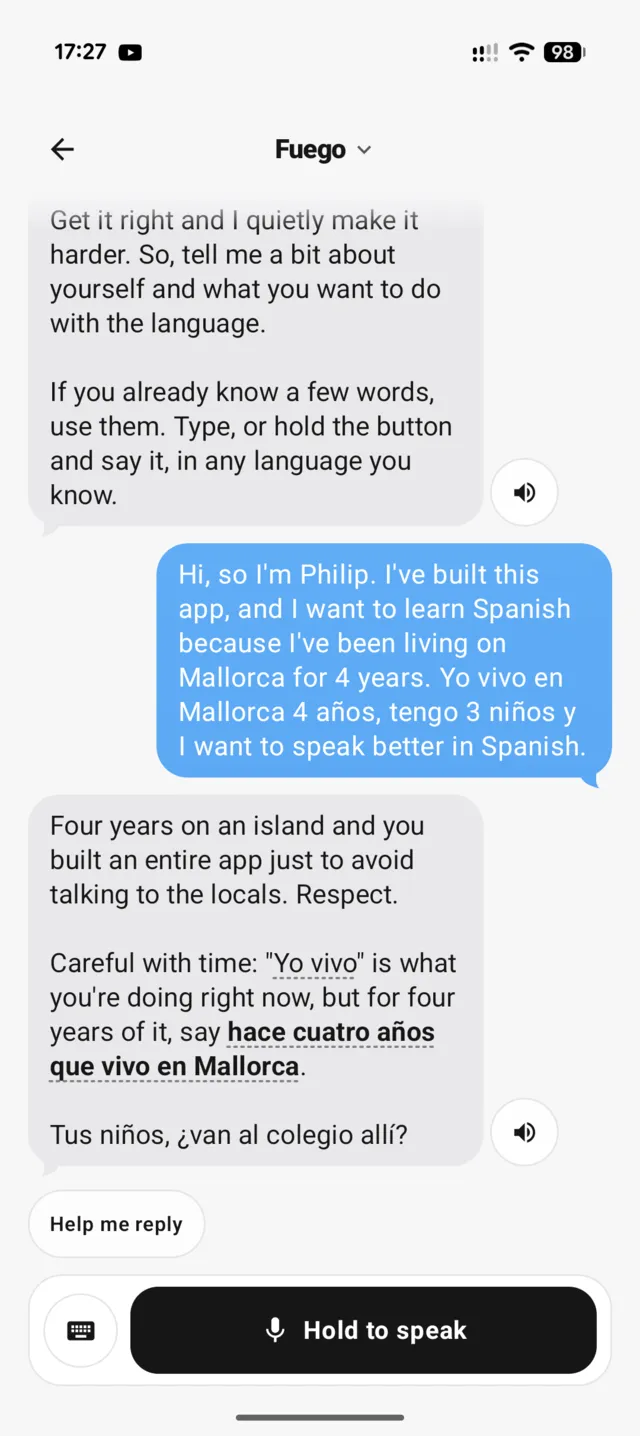
Tell me about your day in whatever Spanish you have. I answer, I keep the conversation going, and I fix the bits that matter.
A first chat
YouAyer yo voy al mercado y compro mucho fruta.
Fuego¡Qué bien! ¿Y qué fruta compraste? Yo siempre acabo con demasiadas naranjas.
Better: Ayer fui al mercado y compré mucha fruta.
Yesterday wants the past tense, so fui and compré. And fruta is feminine, so mucha.
The parts of Spanish I help with most
-
Ser or estar
Two verbs for "to be", and the wrong one changes the meaning. I point it out when it happens, not in a grammar lecture.
-
The two past tenses
Fui or iba? You will mix them up. I show you the right one in your own sentence, then bring it back a few days later.
-
People talk fast
Spanish at full speed is a wall of sound. I can slow my voice down, then speed it up as your ear catches up.
Learning the Spanish of Spain
Spain and Latin America speak one language, and people talk across the ocean without trouble. The differences you notice first are everyday words, vosotros, and one habit with the past tense.
| Meaning | In Spain | In most of Latin America |
|---|---|---|
| You all, among friends | vosotros: ¿Venís esta noche? | ustedes: ¿Vienen esta noche? |
| Computer | el ordenador | la computadora |
| Car | el coche | el carro, el auto |
| Cell phone | el móvil | el celular |
| Juice | el zumo | el jugo |
| To drive | conducir | manejar |
| Apartment | el piso | el departamento, el apartamento |
| Something done today | Hoy he comido paella. | Hoy comí paella. |
Learn vosotros as a set, not as one form. It has its own ending in every tense (habláis, hablasteis, hablaréis), its own pronoun (os) and its own command (venid). Say it in real plans: ¿Qué hacéis este finde? ¿Os apetece cenar fuera?
Put the Spain words into your own sentences, out loud: Cojo el metro, que el coche está en el taller. Se me ha muerto el móvil. A word you have said ten times comes back when you need it.
Most of Spain also says z, and c before e or i, like the th in think: gracias, cerveza. In Latin America they sound like s. You are understood either way. For that sound and the speed of real speech, listen to TV, radio and podcasts made in Spain.
When we talk, I use vosotros and Spain's everyday words, so you meet them in a real conversation, and the 1,000 words in your packs are the ones used in Spain. Already learned Latin American Spanish? Keep it. I never mark ustedes, carro or computadora as mistakes.
Start with the words
- 1 sí yes
- 2 no no
- 3 hola hello
- 4 adiós goodbye
- 5 por favor please
- 6 gracias thank you
- 7 perdón sorry
- 8 disculpe excuse me
Not sure of your level? Take the free Spanish level test.
How lessons go
-
We talk.
Hold to speak, or type. Rough is fine.
-
I review.
After each chat you get a short recap: what went well, the words worth keeping, and the corrections.
-
You practice.
Your mistakes and new words come back as flashcards, listening and reading.
Comparing apps first? Read Learn Spanish with AI: 6 Apps and a Daily Routine (2026).
Planning your time? Read How Long Does It Take to Learn Spanish? Hours by Level, and practice out loud with Spanish Conversation Examples: 12 Dialogues, A1 to B2.
Questions
Can I start Spanish from zero?
Yes. Tell me you are new and I start with short, simple sentences and explain in your language. As you grow, I switch to Spanish a little more each week.
Should I learn Spain Spanish or Latin American Spanish?
Learn the one you will use most: the people you talk to, the place you visit or live in. It is one language, and the differences are mostly words, vosotros and accent, so switching later is easy. I teach the Spanish of Spain, and I accept Latin American forms when you use them.
Do I have to speak out loud?
No. Hold the button and speak when you feel like it, or type. It is the same tutor with the same corrections either way.
Do I need an account?
No. Open the app and start talking. There is nothing to sign up for.
Other languages






First step: today.
Your first lesson is on me. No sign-up.