
Spanish Conversation Examples: 12 Dialogues, A1 to B2
Here are 12 short Spanish conversations from everyday life in Spain, from ordering a coffee (A1) to sorting out a noise complaint with a neighbor (B2), each with the English translation next to it, two or three phrases worth stealing and one grammar note. Read a dialogue out loud, cover the English, then say it again.
- Every line is the Spanish of Spain (vosotros, vale, coger, el móvil), with the English beside it, and the notes say where Latin America says it differently.
- To practice: read it aloud, cover the English, say it again, then change one detail. That last step is where reading turns into speaking.
We wrote every dialogue here ourselves (we make Fuego), and every line uses the Spanish people speak in Spain: vosotros for "you all" among friends, vale for "okay", coger for "take" and el móvil for your phone. If you learned Latin American Spanish, you'll still understand all of it, and we point out the differences where they matter.
Not sure which level to start with? Take our free Spanish level test: about 8 minutes in your browser, no sign-up. Then start with the dialogues one level below your result, so you can focus on speed instead of decoding.
The 12 dialogues at a glance
| # | Situation | Level | What you practice |
|---|---|---|---|
| 1 | Ordering at a café | A1 | Ordering, asking for the bill |
| 2 | Asking for directions | A1 | Estar for location, giving directions |
| 3 | Meeting someone at a party | A1 | Introducing yourself, jobs |
| 4 | Buying clothes | A2 | Sizes, object pronouns |
| 5 | Checking into a hotel | A2 | Formal ustedes, hay que |
| 6 | At the doctor's office | A2 | Doler, describing symptoms |
| 7 | Booking a table by phone | A2 | Phone phrases, polite quería |
| 8 | Making weekend plans | B1 | Vosotros forms, quedar |
| 9 | Moving a meeting at work | B1 | Subjunctive after pedir que |
| 10 | Viewing an apartment to rent | B1 | Rental words, mientras + subjunctive |
| 11 | A noise complaint | B2 | Softening a complaint, past tenses |
| 12 | Arguing about remote work | B2 | Giving and conceding opinions |
Everyday errands: café, directions, shopping

1. Ordering at a café CEFR level A1
Ana and Luis order breakfast at the bar of a café in Madrid.
-
Camarero: Hola, buenos días. ¿Qué os pongo?
Waiter: Hi, good morning. What can I get you?
-
Ana: Para mí, un café con leche, por favor.
Ana: A coffee with milk for me, please.
-
Luis: Y yo, un cortado. ¿Tenéis algo de comer?
Luis: And a cortado for me. Do you have anything to eat?
-
Camarero: Sí, tenemos tostadas, cruasanes y tortilla.
Waiter: Yes, we have toast, croissants and Spanish omelet.
-
Luis: Pues un pincho de tortilla, por favor.
Luis: A slice of omelet, then, please.
-
Ana: ¿Nos cobras cuando puedas?
Ana: Can we pay whenever you're ready?
-
Camarero: Claro. Son seis euros con cincuenta.
Waiter: Sure. That's six fifty.
Useful phrases
- ¿Qué os pongo? "What can I get you (all)?" You'll hear it in almost every bar in Spain.
- Para mí... "For me...", the easiest way to start any order.
- ¿Me cobras? "Can I pay?" Literally "will you charge me?", and the normal way to ask for the bill at a bar.
Grammar note: Os is the object pronoun for vosotros, so ¿Qué os pongo? means "what do I put for you all". In Latin America the waiter would more likely say ¿Qué les traigo?, with les for ustedes.
2. Asking for directions CEFR level A1
A tourist stops a young woman in the street.
-
Turista: Perdona, ¿sabes dónde está la estación de metro?
Tourist: Excuse me, do you know where the metro station is?
-
Chica: Sí, mira, sigue todo recto y coge la segunda a la derecha. Está al lado de una farmacia.
Woman: Yes, look, go straight ahead and take the second right. It's next to a pharmacy.
-
Turista: ¿Está lejos?
Tourist: Is it far?
-
Chica: No, a unos cinco minutos andando.
Woman: No, about five minutes on foot.
-
Turista: Vale, muchas gracias.
Tourist: Okay, thanks a lot.
-
Chica: De nada.
Woman: You're welcome.
Useful phrases
- Todo recto "straight ahead", and a la derecha / a la izquierda "on the right / on the left".
- A cinco minutos andando "five minutes' walk". In Spain people say andando; caminando is more common in Latin America.
Grammar note: Location takes estar, never ser: ¿Dónde está la estación?, Está al lado de una farmacia. And coger ("to take") is an everyday verb in Spain: coge la segunda, cojo el autobús. In much of Latin America it's vulgar, so people there say tomar instead.
3. Meeting someone at a party CEFR level A1
Marta meets Tom, a friend of her brother's.
-
Marta: Hola, soy Marta, la hermana de Pablo. ¿Y tú?
Marta: Hi, I'm Marta, Pablo's sister. And you?
-
Tom: Encantado. Yo soy Tom. Soy de Mánchester, pero vivo en Valencia desde enero.
Tom: Nice to meet you. I'm Tom. I'm from Manchester, but I've lived in Valencia since January.
-
Marta: ¡Anda! ¿Y a qué te dedicas?
Marta: Oh, really! And what do you do?
-
Tom: Trabajo en una empresa de software. ¿Y tú?
Tom: I work at a software company. And you?
-
Marta: Soy enfermera. Oye, hablas muy bien español.
Marta: I'm a nurse. Hey, your Spanish is really good.
-
Tom: ¡Qué va! Todavía me cuesta mucho, pero estoy aprendiendo.
Tom: Not at all! I still find it really hard, but I'm learning.
Useful phrases
- ¿A qué te dedicas? "What do you do (for a living)?"
- ¡Qué va! "No way, not at all", the standard modest answer to a compliment in Spain.
- Me cuesta "I find it hard", followed by a noun or a verb: me cuesta entender a la gente.
Grammar note: Spanish uses the present tense with desde where English uses "have lived": vivo en Valencia desde enero. And jobs take no article after ser: soy enfermera, not soy una enfermera.
4. Buying clothes CEFR level A2
A customer asks for a bigger size in a clothing store.
-
Dependienta: Hola, ¿te puedo ayudar en algo?
Salesclerk: Hi, can I help you with anything?
-
Clienta: Sí, busco esta camiseta en una talla más. ¿La tenéis en la M?
Customer: Yes, I'm looking for this T-shirt one size up. Do you have it in a medium?
-
Dependienta: Espera, que lo miro... Sí, aquí la tienes. Los probadores están al fondo.
Salesclerk: Wait, let me check... Yes, here you go. The fitting rooms are at the back.
-
Clienta: Me queda bien. Me la llevo. ¿Puedo pagar con tarjeta?
Customer: It fits. I'll take it. Can I pay by card?
-
Dependienta: Sí, claro. ¿Quieres bolsa?
Salesclerk: Yes, of course. Would you like a bag?
-
Clienta: No, gracias, no hace falta.
Customer: No, thanks, there's no need.
Useful phrases
- Me queda bien / grande / pequeño "It fits / it's too big / too small on me".
- Me lo llevo / me la llevo "I'll take it", the phrase that closes almost every purchase.
- No hace falta "there's no need", polite and very common.
Grammar note: La stands for la camiseta, so it must agree with it: ¿La tenéis en la M?, me la llevo. For a jacket (el abrigo) it would be ¿Lo tenéis? and me lo llevo. The lo in que lo miro is different: it's the neuter lo, meaning "that" (whether there's one in stock), so it never changes.
Travel and health: hotel, doctor, phone
5. Checking into a hotel CEFR level A2
A couple arrives at reception.
-
Recepcionista: Buenas tardes, bienvenidos. ¿Tienen reserva?
Receptionist: Good afternoon, welcome. Do you have a booking?
-
Huésped: Sí, a nombre de Martín. Una habitación doble para tres noches.
Guest: Yes, under the name Martín. A double room for three nights.
-
Recepcionista: Aquí está. ¿Me dejan un documento de identidad, por favor?
Receptionist: Here it is. Could I have an ID, please?
-
Huésped: Aquí tiene. ¿El desayuno está incluido?
Guest: Here you go. Is breakfast included?
-
Recepcionista: Sí, es de siete y media a diez y media en la primera planta. Su habitación es la 214, y aquí tienen las tarjetas.
Receptionist: Yes, it's from seven thirty to ten thirty on the first floor. Your room is 214, and here are your key cards.
-
Huésped: Perfecto. ¿A qué hora hay que dejar la habitación?
Guest: Great. What time do we have to check out?
-
Recepcionista: Antes de las doce.
Receptionist: Before twelve.
Useful phrases
- A nombre de... "under the name of...", for any booking.
- Aquí tiene "here you are", the formal version of aquí tienes.
- Dejar la habitación "to check out".
Grammar note: Spain keeps ustedes for formal "you all", so the receptionist says ¿Tienen reserva? to the couple; friends would hear ¿Tenéis reserva? And hay que + infinitive means "you have to" in general, with no person attached: hay que dejar la habitación antes de las doce. In Spain, la primera planta is one floor above the ground floor (la planta baja), so a US guest would call it the second floor.
6. At the doctor's office CEFR level A2
A patient sees a doctor at the local health center.
-
Médica: Buenos días, siéntese. ¿Qué le pasa?
Doctor: Good morning, have a seat. What's the matter?
-
Paciente: Desde hace tres días me duele mucho la garganta y tengo un poco de fiebre.
Patient: My throat has been really sore for three days and I have a bit of a fever.
-
Médica: ¿Tiene tos?
Doctor: Do you have a cough?
-
Paciente: Sí, sobre todo por la noche.
Patient: Yes, mostly at night.
-
Médica: A ver, abra la boca... Tiene la garganta bastante inflamada. Le voy a recetar un antiinflamatorio.
Doctor: Let's see, open your mouth... Your throat is quite swollen. I'm going to prescribe an anti-inflammatory.
-
Paciente: ¿Me puede dar un justificante para el trabajo?
Patient: Could you give me a note for work?
-
Médica: Sí, ahora se lo hago.
Doctor: Yes, I'll write it for you now.
Useful phrases
- ¿Qué le pasa? "What's wrong?", formal; with tú it's ¿Qué te pasa?
- Desde hace tres días "for three days (and still now)".
- Un justificante the note that proves you saw a doctor. It's the word you need for work in Spain.
Grammar note: Doler works like gustar: the thing that hurts is the subject. Me duele la garganta, me duelen los pies. Spanish uses the article, not "my": me duele la garganta, never me duele mi garganta.
7. Booking a table by phone CEFR level A2
Sara calls a restaurant for Saturday night.
-
Restaurante: Casa Lola, ¿dígame?
Restaurant: Casa Lola, hello?
-
Sara: Hola, buenas. Quería reservar una mesa para el sábado por la noche.
Sara: Hi there. I'd like to book a table for Saturday night.
-
Restaurante: ¿Para cuántas personas?
Restaurant: For how many people?
-
Sara: Para cuatro. Sobre las nueve y media, si puede ser.
Sara: For four. Around nine thirty, if possible.
-
Restaurante: A las nueve y media lo tengo completo. ¿Le va bien a las diez?
Restaurant: We're fully booked at nine thirty. Would ten work for you?
-
Sara: Sí, perfecto.
Sara: Yes, perfect.
-
Restaurante: ¿A nombre de quién?
Restaurant: What name is it under?
-
Sara: A nombre de Sara Gómez.
Sara: Sara Gómez.
-
Restaurante: Muy bien, apuntado. Hasta el sábado.
Restaurant: Great, it's down. See you Saturday.
Useful phrases
- ¿Dígame? how people answer the phone at work in Spain. At home, people often answer with ¿Sí? or ¿Diga?
- Si puede ser "if possible", the softener that makes any request sound polite.
- ¿Le va bien...? "Does ... work for you?", formal; with tú it's ¿Te va bien...?
Grammar note: Quería reservar uses the imperfect tense, but it isn't about the past. Spanish speakers use quería ("I wanted") to make a request softer, the way English uses "I'd like". It's the safest way to open any call or order.
Social life: plans, work, home
8. Making weekend plans CEFR level B1
Three friends plan a hike in the hills outside Madrid.
-
Lucía: ¿Qué hacéis este finde?
Lucía: What are you guys doing this weekend?
-
Dani: Nada especial. ¿Por?
Dani: Nothing much. Why?
-
Lucía: Estaba pensando en ir a la sierra el sábado a hacer una ruta. ¿Os apuntáis?
Lucía: I was thinking of going up to the mountains on Saturday for a hike. Are you in?
-
Irene: Yo me apunto, pero solo si no hace mucho calor.
Irene: I'm in, but only if it's not too hot.
-
Dani: Yo el sábado no puedo, tengo una boda. Si fuera el domingo, sí.
Dani: I can't on Saturday, I've got a wedding. If it were Sunday, I'd come.
-
Lucía: Pues lo movemos al domingo. Quedamos a las ocho en la estación, ¿vale?
Lucía: Then let's move it to Sunday. We'll meet at eight at the station, okay?
-
Irene: ¿A las ocho? ¡Qué madrugón...! Venga, vale.
Irene: At eight? That's so early... Fine, okay.
Useful phrases
- ¿Te apuntas? / ¿Os apuntáis? "Are you in?", the standard way to invite people in Spain.
- Quedar "to meet up": ¿Quedamos mañana?, he quedado con Ana.
- Qué madrugón "what an early start", from madrugar, to get up early.
Grammar note: This is vosotros in action: hacéis, os apuntáis. Every verb has its own vosotros form, and in most of Spain it's what friends use with each other. Latin America uses ustedes for the same group (¿Qué hacen este finde?). Spaniards understand both, so use whichever you learned, but expect to hear vosotros everywhere in Spain.
9. Moving a meeting at work CEFR level B1
Elena catches her colleague Javi between tasks.
-
Elena: Oye, Javi, ¿tienes un momento?
Elena: Hey, Javi, do you have a minute?
-
Javi: Sí, dime.
Javi: Sure, go ahead.
-
Elena: Es sobre la reunión con el cliente. Me han escrito esta mañana para pedirnos que la pasemos al jueves.
Elena: It's about the client meeting. They wrote to me this morning asking us to move it to Thursday.
-
Javi: ¿Al jueves? Uf, el jueves por la mañana tengo formación. ¿Podría ser por la tarde?
Javi: Thursday? Ugh, I have training on Thursday morning. Could it be in the afternoon?
-
Elena: Les propongo las cuatro y te confirmo. ¿Te parece bien que prepare yo la presentación y tú revises las cifras?
Elena: I'll suggest four o'clock and let you know. Is it okay if I prepare the presentation and you check the figures?
-
Javi: Perfecto. Mándamela cuando la tengas y le echo un vistazo.
Javi: Perfect. Send it to me when you have it and I'll take a look.
Useful phrases
- Dime "go ahead, tell me", the normal reply when someone asks for a moment.
- Echar un vistazo "to take a look".
- Te confirmo "I'll confirm with you", a workplace staple.
Grammar note: Three uses of the present subjunctive in one exchange: after pedir que (pedirnos que la pasemos), after te parece bien que (que prepare, que revises) and after cuando for something that hasn't happened yet (cuando la tengas). Note also me han escrito esta mañana: in Spain, the present perfect is the usual tense for something that happened earlier today.
10. Viewing an apartment to rent CEFR level B1
A tenant visits an apartment with the owner.
-
Propietario: Pues este es el salón. Le da el sol toda la mañana.
Owner: So this is the living room. It gets the sun all morning.
-
Inquilina: Es muy luminoso. ¿Los gastos de comunidad están incluidos en el alquiler?
Tenant: It's very bright. Are the building fees included in the rent?
-
Propietario: La comunidad sí. La luz, el agua y el gas van aparte.
Owner: The building fees are, yes. Electricity, water and gas are extra.
-
Inquilina: ¿Y cuánto es la fianza?
Tenant: And how much is the deposit?
-
Propietario: Un mes, y el contrato es de un año.
Owner: One month's rent, and the contract is for a year.
-
Inquilina: ¿Se admiten mascotas? Tengo un gato.
Tenant: Are pets allowed? I have a cat.
-
Propietario: Mientras no dé problemas, no hay inconveniente.
Owner: As long as it doesn't cause problems, that's fine.
-
Inquilina: Me gusta mucho. ¿Le importa si me lo pienso hasta mañana?
Tenant: I really like it. Do you mind if I think it over until tomorrow?
Useful phrases
- Gastos de comunidad the monthly fees for the building, a line on every rental ad in Spain.
- La fianza "the deposit".
- Me lo pienso "I'll think it over", a polite way to buy time.
Grammar note: Mientras followed by the subjunctive means "as long as": mientras no dé problemas. With the indicative it means "while": mientras cocino, escucho la radio. And piso is the everyday word for an apartment in Spain; departamento and apartamento are what you'd hear in much of Latin America.
Harder conversations: complaints and opinions
11. A noise complaint CEFR level B2
Carmen, who lives on the third floor, knocks on her neighbor's door the morning after a party.
-
Carmen: Hola, perdona que te moleste. Soy Carmen, la del tercero.
Carmen: Hi, sorry to bother you. I'm Carmen, from the third floor.
-
Álex: Ah, hola. ¿Pasa algo?
Álex: Oh, hi. Is something wrong?
-
Carmen: Mira, no quiero ser pesada, pero anoche la música estuvo muy alta hasta las tres y no pegué ojo. Y hoy tenía que madrugar.
Carmen: Look, I don't want to be a pain, but last night the music was really loud until three and I didn't sleep a wink. And I had to get up early today.
-
Álex: Vaya, lo siento muchísimo. Era el cumpleaños de mi compañero de piso y se nos fue de las manos.
Álex: Oh no, I'm really sorry. It was my roommate's birthday and it got out of hand.
-
Carmen: Lo entiendo, nos pasa a todos. Solo te pido que, si hacéis otra fiesta, bajéis la música a partir de las doce.
Carmen: I get it, it happens to everyone. I'm just asking that if you have another party, you turn the music down after midnight.
-
Álex: Por supuesto. Y si vuelve a pasar, llama al timbre directamente, que no me molesta.
Álex: Of course. And if it happens again, just ring the bell, I won't mind.
Useful phrases
- Perdona que te moleste "sorry to bother you", always followed by the subjunctive.
- No quiero ser pesado/pesada "I don't want to be a pain", the softener before a complaint.
- Se nos fue de las manos "it got out of hand".
Grammar note: Watch the past tenses. La música estuvo muy alta hasta las tres uses the preterite because the noise had a clear end. Era el cumpleaños uses the imperfect because it sets the background. Tenía que madrugar is imperfect too: it describes the obligation she had, not a finished event.
12. Arguing about remote work CEFR level B2
Raúl and Nuria disagree over dinner.
-
Raúl: Yo no volvería a la oficina ni loco. Teletrabajando me ahorro dos horas de transporte al día.
Raúl: No way would I go back to the office. Working from home saves me two hours of commuting a day.
-
Nuria: Ya, pero a mí me parece que se pierde mucho. Desde que trabajamos en casa, apenas conozco a la gente nueva del equipo.
Nuria: Sure, but I think you lose a lot. Since we started working from home, I barely know the new people on the team.
-
Raúl: Puede ser, aunque eso se soluciona quedando de vez en cuando.
Raúl: Maybe, but you can fix that by meeting up now and then.
-
Nuria: No sé, no lo tengo tan claro. Echo de menos tomarme un café con alguien sin tener que programar una videollamada.
Nuria: I don't know, I'm not so sure. I miss having a coffee with someone without having to schedule a video call.
-
Raúl: Bueno, en eso te doy la razón.
Raúl: Well, I'll give you that.
-
Nuria: ¿Ves? Lo ideal sería un término medio: dos o tres días en la oficina y el resto en casa.
Nuria: See? The ideal would be a middle ground: two or three days in the office and the rest at home.
Useful phrases
- Ni loco / ni loca "no way", literally "not even if I were crazy".
- Te doy la razón "you've got a point, I'll give you that".
- No lo tengo tan claro "I'm not so sure", a soft way to disagree.
Grammar note: The gerund can work as a condition or a means: teletrabajando me ahorro dos horas ("by working from home"), se soluciona quedando ("it's fixed by meeting up"). And ya, pero... is how people in Spain concede a point before they disagree. They're the two most useful words in any argument.
How should you practice with these dialogues?
Pick one dialogue a day at your level. Read it aloud twice with the English visible, then cover the English column and read the Spanish again. Next, cover the Spanish, look only at the English and try to say the Spanish lines from memory. Finally, change one detail and say it again: order a té instead of a cortado, ask for the M in a jacket instead of a T-shirt. That last step is where reading turns into speaking.
For a full weekly method, see our guide to Spanish conversation practice. If you have nobody to try the lines on, our page on how to practice speaking without a partner has a 15-minute routine you can do alone.
What do written dialogues leave out?
They can't answer back. In a real café the waiter mumbles, the bar has run out of tortilla and the person next to you asks where you're from. A script trains you for the lines you expect, and real conversations are mostly the lines you didn't. These dialogues also have no audio on this page, so they won't train your ear. For listening, our 1,000 common Spanish words list has a native audio clip for every word, free in your browser.
Want a conversation that answers back?
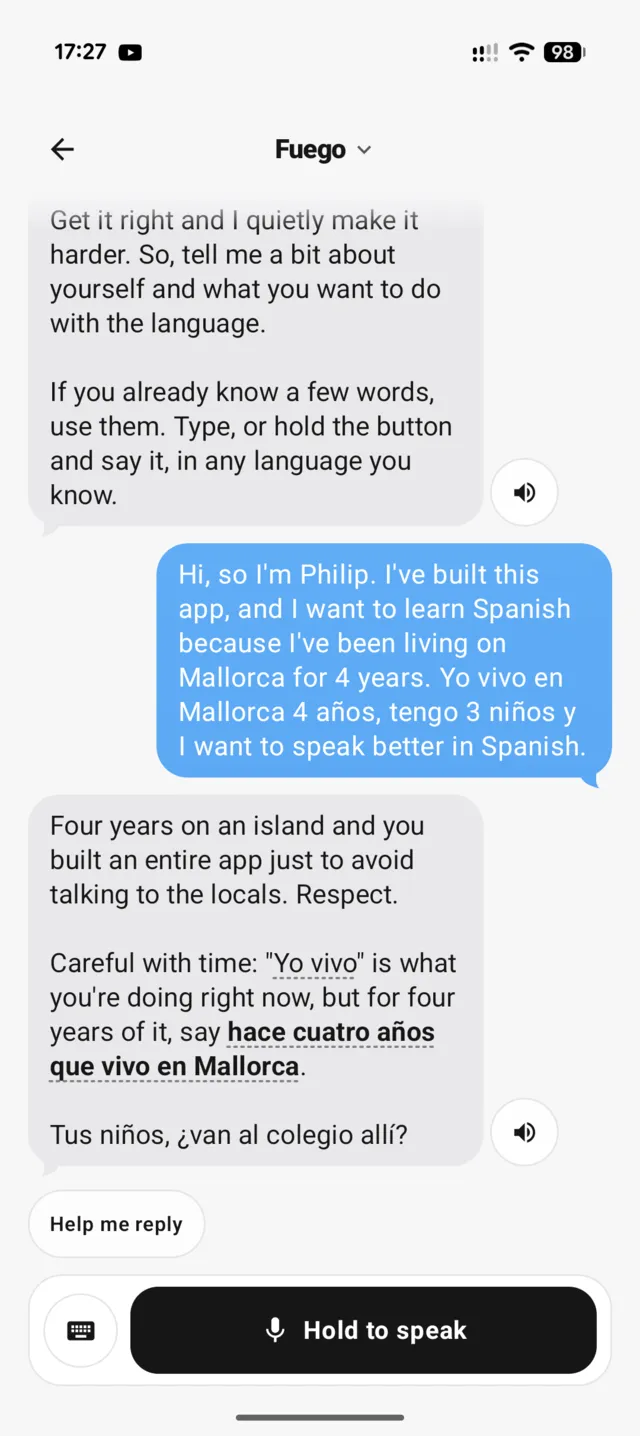
That's where Fuego comes in. Fuego is an AI language tutor you talk to by voice or by text: hold a button and speak, let go and hear the reply, or type if you're on a train. The tutor picks the topic, keeps the conversation going and shows you the corrected sentence with a one-line reason. For Spanish, it speaks the Spanish of Spain, the same variety as the dialogues above, and it never marks your Latin American forms as mistakes. A sample of the shape, written by us:
You: Ayer he quedado con mis amigos en un bar y hemos pedido unas cañas.
Fuego: ¡Qué buen plan! ¿Y en qué bar estuvisteis? ¿Pedisteis algo de picar?
Better: Ayer quedé con mis amigos y pedimos unas cañas.
With ayer, use the preterite, even in Spain.
You can replay any reply at a slower speed and tap a word to translate it. After each conversation you get a recap with the words worth keeping and your corrections.
Fuego isn't a script, so it won't walk you through these exact twelve scenes, and it needs an internet connection. It's a subscription app: your first conversation with the tutor is free, and words, flashcards, reading, listening and the daily plan stay free. The store shows the price in your country.
Frequently asked questions
What is a basic conversation in Spanish?
A basic conversation covers greetings, your name, where you're from and what you do: Hola, soy Tom. Soy de Mánchester. ¿Y tú? Dialogues 1 to 3 on this page are basic A1 conversations. Once you can handle those without reading, move to A2, where you start using object pronouns and talking about the past.
Are these dialogues in Spain Spanish or Latin American Spanish?
Spain Spanish. They use vosotros, vale, coger, piso and móvil, and the grammar notes point out where Latin America says it differently. Everything here would be understood across the Spanish-speaking world; only a few words and the vosotros forms would sound Spanish to a listener in Mexico or Colombia.
What level is A1, A2, B1 or B2?
These are levels of the Common European Framework of Reference (CEFR). A1 handles simple, familiar exchanges; A2 manages routine tasks like shopping or booking; B1 can deal with most everyday situations and give reasons; B2 can argue a point and talk with native speakers without much strain. Our free Spanish level test gives you an estimate in about 8 minutes.
How do I use a dialogue to improve my speaking?
Say it, don't just read it. Read it aloud, cover one language and produce the other, then change a detail and say it again. Repeat the same dialogue on three different days rather than ten dialogues once. Our guide to Spanish conversation practice turns this into a weekly plan.
When should I use tú, usted, vosotros or ustedes in Spain?
Use tú with friends, people your age and most shop staff, and usted with older strangers, doctors and formal settings. For a group, vosotros is informal and ustedes formal. Spain uses tú more than most of Latin America, so if in doubt with someone your age, tú is fine.
Do these dialogues have audio?
Not yet. This page is text only. For pronunciation, start with our 1,000 common Spanish words list, which has a native audio clip for every word, or practice the dialogues with a speaking partner or an AI tutor that talks back.
Sources checked October 6, 2026
- Real Academia Española, Diccionario panhispánico de dudas: vosotros, vosotras and usted (where vosotros is used and where ustedes replaces it)
- Council of Europe: CEFR global scale, common reference levels
- Pages read for the field: Jumpspeak, Spanish conversation examples, SpanishBOOM, dialogues in Spanish, Loora, English conversation dialogues
- Fuego: the app as it stood on October 6, 2026
Related guides
- 1,000 common Spanish words and the Spanish level test
- Learn Spanish with Fuego
- Best Duolingo Alternatives in 2026: 8 Apps Compared
- Babbel vs Duolingo (2026): Which Language App to Pick
- Speak with an AI Language Tutor: 7 Apps Compared (2026)
- Learn Spanish with AI: 6 Apps and a Daily Routine (2026)
- How Long Does It Take to Learn Spanish? Hours by Level
- Does Duolingo Work? What the Research Says (2026)
- Spanish Conversation Practice: 6 Methods and a Weekly Plan
- How to Practice Speaking a Language Without a Partner
- Fuego vs Praktika: Daily Review or Avatar Tutors?
- Fuego vs Speak: A Daily Plan or a Spoken Course?
- Fuego vs Langua: Daily Activities or Flexible Calls?
- Fuego vs Talkpal: Daily Review or More Language Choice?
- Fuego vs Pingo AI: Conversation and What Comes After
- Praktika Alternatives: Choose by Your Learning Goal
- Duolingo Max Alternatives for Conversation Practice
- Best App to Learn Polish: Choose by Your Study Goal