How to Practice Speaking a Language Without a Partner
You can practice speaking without a partner by doing three things out loud every day: copy native audio (shadowing), describe your day to yourself, and hold a short conversation with something that answers back, such as an AI tutor. Record yourself once a week so you can hear the change. Fifteen minutes a day is enough to start.
- Start from your situation: you freeze when you answer, nobody around you speaks the language, you feel nervous, an event is coming up, or you only have a commute.
- The 15-minute routine: shadow, talk to yourself, answer out loud, converse, then fix one thing. Record yourself once a week.
- Solo practice builds speed and confidence but cannot give you a real listener, so add people when you can.
What works best depends on why you have no partner and what goes wrong when you try to speak. Find your situation below, then use the routine further down. The examples are in Spanish, but every tactic works in any language.
Before you start: if you're learning Spanish, our free Spanish level test takes about 8 minutes in your browser and tells you which level of material to use. Then pick a dialogue at that level from our 12 Spanish conversation examples.
You understand a lot, but freeze when you have to answer
This is the most common situation, and it has a clear cause: you've practiced recognizing the language, not producing it. Recognition and recall are different skills. Reading ¿A qué te dedicas? and knowing what it means is easy; answering in two seconds is a separate skill you haven't trained yet.
Train the answer, not the question. Write ten questions you'd expect in a first conversation (where you're from, what you do, why you're learning, what you did on the weekend) and answer each one out loud with a 30-second timer running. Don't stop to fix mistakes. When the timer ends, say the answer again, a little longer. Do the same ten questions for a week, then write ten new ones.
Example: ¿Por qué aprendes español? "Porque mi pareja es de Sevilla y quiero hablar con su familia. Su abuela no habla inglés, y en Navidad no entendí casi nada."
The point isn't a perfect answer. It's getting a sentence out before your brain asks for permission.
Nobody around you speaks the language
Then you have to supply the sound and the speaking yourself.
Shadowing. Play a clip of native speech and speak along with it a fraction of a second behind, copying speed and melody. The applied linguist Yo Hamada, who has published on the technique for years, gives practical numbers: understand the content first, shadow without reading a transcript, switch to a new clip after five or six run-throughs, and expect a noticeable change from two 10 to 15 minute sessions a week for about a month. His evidence is mainly about hearing the language better, which is exactly what you lack when nobody around you speaks it.
Self-talk. Narrate what you're doing in the present tense: Estoy fregando los platos. Se me ha acabado el café. Tengo que ir al súper antes de las nueve. Then retell your day in the past before bed. Narration costs nothing and shows you, very fast, which everyday words you don't have.
Voice notes to yourself. Send yourself a one-minute voice message in the language each evening, as if to a friend: what happened today, one thing you're looking forward to. Listen to last week's message before you record the new one.
You feel silly or nervous speaking out loud
You're not alone in this. Researchers have studied it as "foreign language anxiety" since Horwitz, Horwitz and Cope described it in 1986, and much of what learners report is about speaking in front of other people. Solo practice is the right place to start because there's no audience, but you can still make the first steps smaller.
Start by whispering, then speak at a normal volume in an empty room. Type your answers before you say them, then say them without looking. If talking to a chatbot feels easier than talking to a person, use that: a conversation with an AI is still a conversation, and nobody is waiting for you to finish.
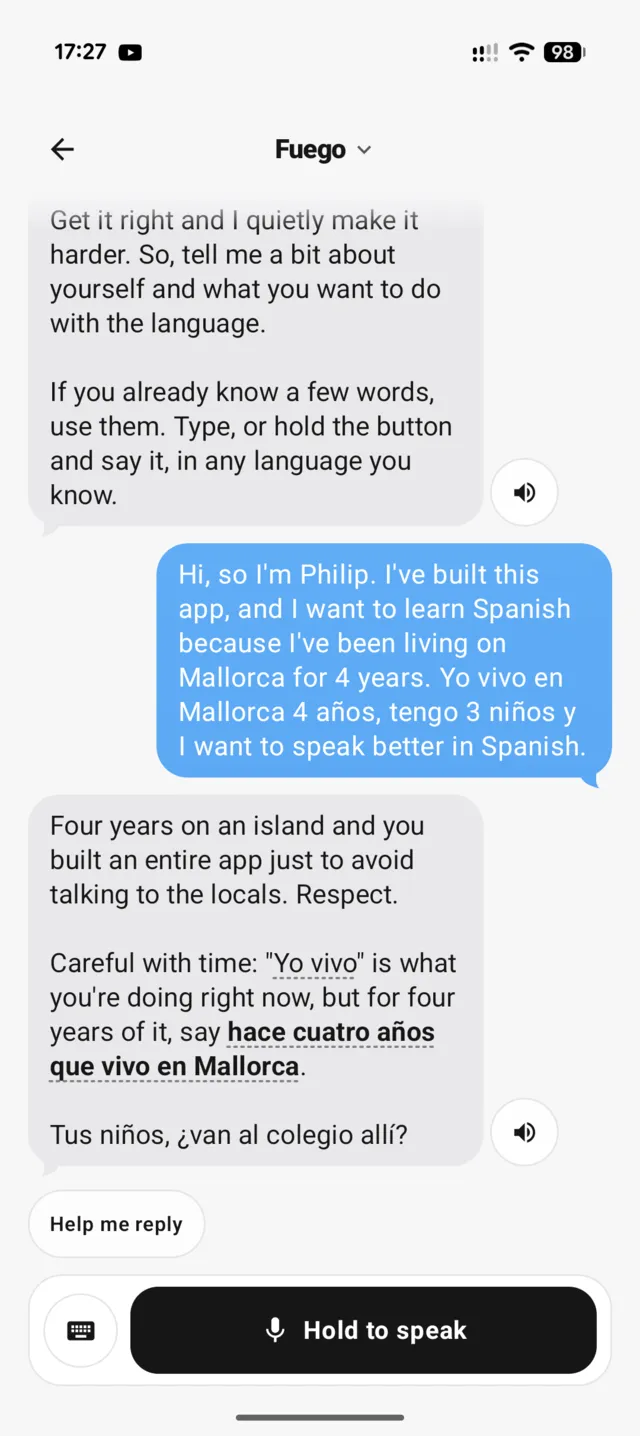
We make Fuego, an AI language tutor, partly for this situation. You can type or hold a button to speak, and you can set the tutor's tone, from warm and friendly to sarcastic, so the conversation feels the way you need it to. If you're stuck, reply suggestions give you somewhere to start. A sample of the shape, written by us:
You: Perdón, mi español es muy malo. Quiero practicar para mi viaje en Sevilla.
Fuego: ¡Pues a mí me parece que se te entiende perfectamente! ¿Cuándo te vas? Y cuéntame, ¿qué te apetece ver allí?
Better: Mi viaje a Sevilla.
A trip goes to a place, so use a, not en.
You have a trip, an interview or a dinner coming up
Rehearse the scene, both sides of it. Write the conversation you expect, with your lines and the other person's, then read it aloud playing both roles. Next, play only your part and improvise the replies you might get. Finally, change one thing (the waiter says they've run out, the interviewer asks why you left your last job) and see whether you can keep going.
Example, a hotel check-in: you write ¿Tienen reserva? / Sí, a nombre de Martín. Then you rehearse the surprise: Lo siento, no aparece ninguna reserva a ese nombre. What do you say now?
Our 12 Spanish conversation examples give you ready-made scenes for cafés, hotels, doctors and phone calls, each with the phrases you're most likely to need.
You only have your commute
Use headphones and the time you already spend. On a bus or train, shadow under your breath or mouth the words; on a walk or in the car, speak at full volume. Between clips, describe what you see: Hay mucho tráfico hoy. El autobús va lleno. If you can't speak at all where you are, type a short conversation with an AI tutor instead. It still forces you to build sentences, which reading never does.
A 15-minute daily routine for speaking alone
Do it in this order, at the same time each day.
- Shadow (3 minutes). One short clip, two or three passes. Same clip all week.
- Self-talk (3 minutes). Narrate what you did since you woke up, in the past tense.
- Answer out loud (4 minutes). Four questions from your list, with the 30-second timer.
- Converse (4 minutes). A short conversation with something that answers back: an AI tutor, or a scene you rehearse playing both parts.
- Fix one thing (1 minute). Pick one mistake you noticed today and say the corrected sentence aloud three times.
Once a week, swap steps 3 and 4 for a two-minute recording on a single question, and keep every recording. After a month, play the first and the latest one back to back.
What mistakes waste solo speaking practice?
Reading aloud and calling it speaking. Reading trains pronunciation, but the words are already chosen for you. Unless you're producing your own sentences, you aren't practicing what you freeze on.
Looking up every word mid-sentence. Say it the long way round (la cosa para abrir el vino instead of sacacorchos) and look it up afterward. Talking around a missing word is a skill you'll need in every real conversation.
Never listening back. Without a recording or a correction, you can repeat the same mistake for months. Solo practice needs at least one source of feedback each week.
Only rehearsing scripts. Scripts are great for a known event, but real conversations go off script within a minute. Mix in free speaking every day.
Waiting until you're ready. Nobody feels ready. Speaking early is how you find your gaps early, while they're still easy to fix.
What can't solo practice give you?
Two things. First, a real listener: solo work won't prepare you for someone who talks fast, mumbles, or answers something you didn't expect. Second, feedback you didn't know to look for. Recordings only show you errors you can already hear, and an AI tutor can occasionally get a correction wrong. Use solo practice to build speed and confidence, then add real people when you can: a language exchange, a tutor, or a friend who speaks the language. Our Spanish conversation practice guide compares those options and puts them into a weekly plan.
Where does Fuego fit?
Fuego covers step 4 of the routine. You talk to the tutor by voice or by text, in English, Spanish, French, German, Italian, Portuguese or Polish. For Spanish, it speaks the Spanish of Spain. The tutor picks the topic, answers and asks you something back, and shows the corrected sentence with a one-line reason. You can replay any reply at a slower speed, and after each conversation the recap lists your corrections and the words worth keeping; the words you struggled with shape your next flashcards.
It isn't a person, it needs an internet connection, and it runs on iPhone, iPad and Android only. Fuego is a subscription app: your first conversation with the tutor is free, and words, flashcards, reading, listening and the daily plan stay free.
Frequently asked questions
Can you learn to speak a language without speaking to anyone?
You can get a long way. Shadowing, self-talk and an AI tutor build speed, vocabulary recall and confidence. But understanding real people at real speed takes real people, so plan to add a few human conversations once you can hold a short exchange alone.
Is talking to yourself in another language actually useful?
Yes, as long as you produce your own sentences instead of repeating memorized ones. Narrating your day forces you to find words for ordinary things, and it shows you which ones you're missing. Look those up afterward and use them the next day.
How long should I practice speaking each day?
Fifteen minutes a day is a good start, and daily beats a long weekly session. The routine above fits in that time. If you have more, add a second block of shadowing or a longer conversation rather than extending everything.
What is shadowing in language learning?
Shadowing means speaking along with a native recording a split second behind it, copying the speed, rhythm and melody. Use a short clip you already understand, shadow it without the transcript, and move on after five or six passes. It mainly trains your ear and your pronunciation.
Is a language exchange partner better than an AI tutor?
They do different jobs. An exchange partner is a real person with a real accent and costs nothing, but half the time is in your language and they aren't a teacher. An AI tutor is available whenever you are and corrects every turn, but it isn't a person. Many learners use an AI tutor daily and an exchange weekly.
How do I practice speaking Spanish alone?
Use the routine on this page with Spanish material: shadow a clip from a Spanish podcast or series, narrate your day, answer questions out loud and rehearse scenes from our Spanish conversation examples. For a full week that also includes people, see our Spanish conversation practice guide.
Sources checked October 6, 2026
- Yo Hamada, "Shadowing for language teaching", TESL Ontario CONTACT Magazine, August 2018 (citing Hamada 2016 and Shiki et al. 2010)
- Horwitz, Horwitz and Cope, "Foreign Language Classroom Anxiety", The Modern Language Journal 70(2), 1986; and Tran Thi Thu Trang, "A review of Horwitz, Horwitz and Cope's theory of foreign language anxiety", English Language Teaching 5(1), 2012
- Pages read for the field: Pimsleur, practicing speaking with no one to talk to, Lingopie, speaking without a partner, Talkpal, practicing without a conversation partner
- Fuego: the app as it stood on October 6, 2026
Related guides
- 1,000 common Spanish words, Spanish level test
- Learn Spanish with Fuego
- Best Duolingo Alternatives in 2026: 8 Apps Compared
- Babbel vs Duolingo (2026): Which Language App to Pick
- Speak with an AI Language Tutor: 7 Apps Compared (2026)
- Learn Spanish with AI: 6 Apps and a Daily Routine (2026)
- How Long Does It Take to Learn Spanish? Hours by Level
- Does Duolingo Work? What the Research Says (2026)
- Spanish Conversation Examples: 12 Dialogues, A1 to B2
- Spanish Conversation Practice: 6 Methods and a Weekly Plan
- Fuego vs Praktika: Daily Review or Avatar Tutors?
- Fuego vs Speak: A Daily Plan or a Spoken Course?
- Fuego vs Langua: Daily Activities or Flexible Calls?
- Fuego vs Talkpal: Daily Review or More Language Choice?
- Fuego vs Pingo AI: Conversation and What Comes After
- Praktika Alternatives: Choose by Your Learning Goal
- Duolingo Max Alternatives for Conversation Practice
- Best App to Learn Polish: Choose by Your Study Goal