Babbel vs Duolingo (2026): Which Language App to Pick
Pick Babbel if you want a structured course that explains the grammar and you are willing to pay for it. Pick Duolingo if you want to start free, build a daily habit and learn a wider choice of languages. Both teach you to read and recognize far more than they get you to speak, so if conversation is your goal, plan to add speaking practice whichever one you choose.
- Pick Babbel for a structured course that explains the grammar, written for speakers of your language. The first lesson of every course is free; a full course is paid.
- Pick Duolingo to start free, build a daily habit and choose from more than 40 languages, against Babbel's 14.
- For speaking, Babbel Speak is guided and in beta, and Duolingo's open Video Call needs Max and does not correct your grammar.
Below we compare the two on method, grammar, speaking, languages, free access and price model, then split the verdict by what you are trying to do.
How do Babbel and Duolingo compare side by side?
As of October 2026, from each company's own website and US App Store listing. Free access and plans change, so check the store for the price in your country.
| Babbel | Duolingo | |
|---|---|---|
| Method | Short lessons built around real-life dialogues | Game-like lessons on a path of units |
| Grammar explanations | Built into the lessons | Explain My Answer, free since January 2026 |
| Speaking practice | Speech recognition; Babbel Speak (beta) | Speaking exercises; Video Call on Max |
| Languages offered | 14, including English | 40+ |
| Free access | First lesson of every course; Babbel Speak | Full courses, with ads and energy |
| Paid model | Subscription per language, or lifetime | Super or Max subscription |
| Platforms | iOS, Android, web | iOS, Android, web |
How did we compare them?
We read each company's own pages on October 6, 2026: Babbel's homepage, its review and Babbel Speak pages, its help center and its US App Store listing; Duolingo's blog posts on energy, Video Call, speaking and Explain My Answer, its 2025 language report and its US App Store listing. Where a feature depends on the plan or the language, we say so. We left out prices because they change by country, by plan length and by sale, and the store shows you yours. We also left out each company's own effectiveness numbers from the verdict; where one appears below, we name the company that published it. We make Fuego, a different kind of app, and it appears once, in the section about what neither app does well.
How do the two apps teach?
The two companies start from different ideas about what keeps you learning.
Babbel builds courses the way a good textbook would, only shorter. Its lessons take 10 to 15 minutes, they are written by a team Babbel puts at more than 200 language experts, and each course is tailored to your native language, so an English speaker learning German gets explanations aimed at English speakers' mistakes. Lessons follow conversations you would actually have, and Babbel explains the grammar as it comes up.
Duolingo organizes each course into units with a communication goal, and each unit is a run of bite-sized exercises that start easy (recognize a word) and get harder (type it yourself). Duolingo aligns its major courses with the CEFR, the European scale that runs from A1 to C2. The app wraps all of this in a game: streaks, XP, weekly leagues and an energy meter that free users spend as they go. Its practice lessons focus on the mistakes you have made.
Neither approach is wrong. Babbel asks for a bit more attention per session and gives you more understanding in return; Duolingo asks for very little and gets you back every day.
Which is better for a beginner on a budget?
Duolingo, clearly. You can take every lesson in every course without paying. The free plan shows ads and uses energy: each exercise uses a little, a run of correct answers earns some back, and the meter refills in about a day. Super Duolingo removes the ads and gives you unlimited energy, and the App Store currently offers it with a 14-day free trial.
Babbel's free access is narrower. You can take the first lesson of every course, and Babbel says some languages have more free lessons at different levels, plus free access to Babbel Speak for registered users. That is enough to see whether you like the method, not enough to learn a language. After that you pay, and a subscription covers one language.
If money is the deciding factor, start on Duolingo. If you later find yourself guessing at why sentences work, that is the moment to look at Babbel.
Which app explains grammar better?
Babbel. Explaining grammar is the core of its method rather than an add-on: rules appear inside the lessons, in your own language, at the point where you need them. For learners who like to understand a pattern before they practice it, this is the main reason to pay.
Duolingo has closed some of the gap. Explain My Answer, which tells you why an answer was right or wrong, used to need a subscription and became free for all learners on January 1, 2026, starting with Spanish, French, German, Japanese, Portuguese, Italian and Korean. Duolingo Max adds further grammar explanations. Still, Duolingo mostly teaches grammar by having you do it many times, and many learners only see the explanation after they get something wrong.
Which is better for travel?
For a trip with a date on it, Babbel has the edge. Its lessons are built around dialogues you would use in real life, it lets you download lessons for offline use in the app, and the course moves through practical situations in a clear order. You know where you are and what is left.
Duolingo works if your trip is a long way off and you mainly want enough vocabulary to read signs and menus. Its range also matters here: if you are heading somewhere whose language Babbel does not teach, such as Japan, Korea or China, Duolingo is the only one of the two with a course.
Either way, an app course mostly trains reading and understanding. Ordering, asking for directions and following a quick answer is a speaking skill, which brings us to the next question.
Which is better for speaking practice?
Both companies now offer some AI speaking practice, and each comes with a limit: Babbel's is guided and in beta, Duolingo's open conversation needs its top plan.
Babbel uses speech recognition in its lessons to check your pronunciation, and Babbel Speak, an AI feature in open beta, walks you through spoken conversations step by step in Spanish (Spain and Mexico), German, French and Italian. It is free for registered users. It follows guided scenarios rather than open chat.
Duolingo gives you speaking exercises from the first lesson: repeating words, translating sentences out loud and short dialogues, and you can answer many writing exercises by voice instead. Duolingo Max adds Roleplay, short scenes with its characters, and Video Call, where you talk with the character Lily about any topic. When Duolingo launched Video Call, it said the calls last about a minute for beginners and up to three minutes later on, and that Lily does not correct grammar mistakes during the call.
Our read: Duolingo Max offers the more open conversation, Babbel Speak the more guided one, and neither is designed to be where you spend most of your speaking time.
What is each app genuinely good at?
Babbel's strengths. It explains things. Courses are written for speakers of your language, lessons are short enough for a lunch break, and a lifetime plan exists if you dislike subscriptions. Its languages are mostly European, from Spanish and French to Polish, Turkish, Swedish and Indonesian, and it teaches both Spain and Mexican Spanish.
Duolingo's strengths. It gets people to come back. The streak, the leagues and the short lessons make daily practice feel easy, and it costs nothing to keep going. It teaches more than 40 languages, plus math, music and chess. Duolingo states that completing five sections of its course teaches as much as five semesters of university classes; that is the company's own claim, based on research it links from its blog.
What does neither app do well?
Open conversation. Both apps teach you to recognize, read and produce sentences inside an exercise. Neither is built for the thing most learners eventually want: twenty minutes of talking where you say what you want to say, get stuck, find another way to say it, and get corrected. Babbel Speak is guided and in beta. Duolingo's Video Call is short, sits in the top plan, and by Duolingo's description does not correct your grammar while you talk.
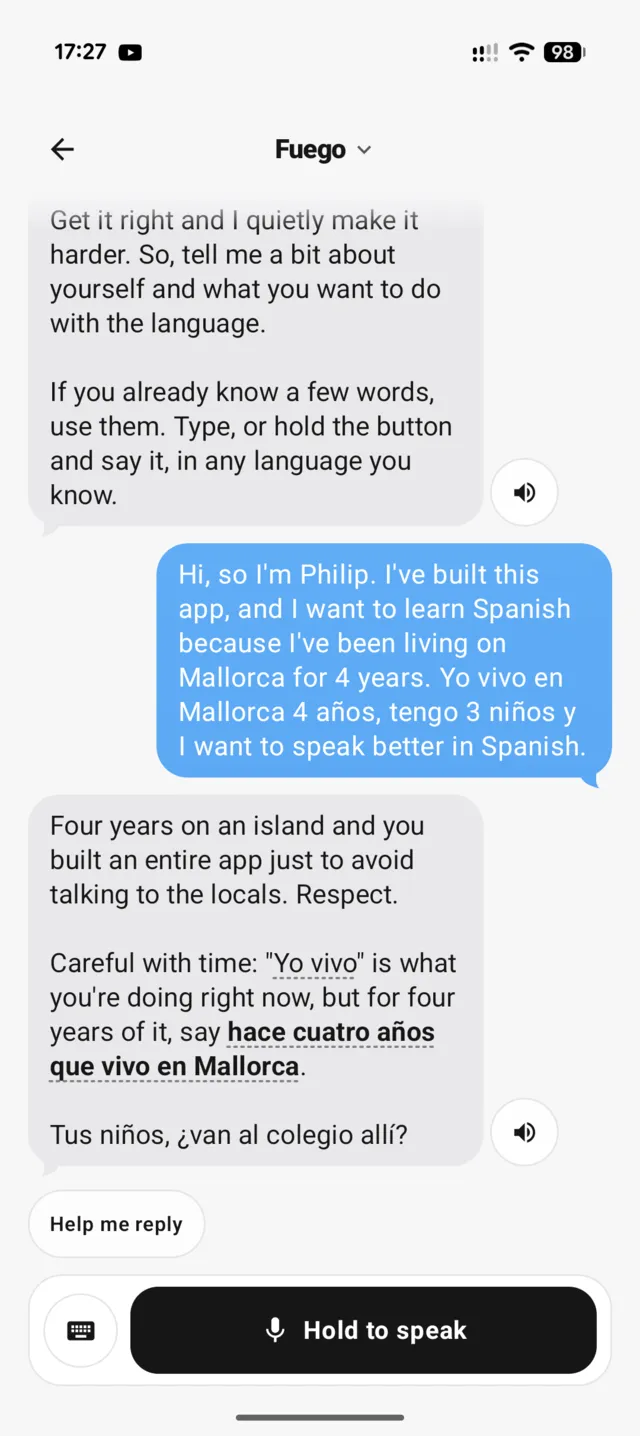
That gap is why we make Fuego, an AI tutor you talk to by voice or by text. It answers, keeps the conversation going, corrects your mistakes and adapts to your level, and after each session you get a recap with your corrections and the words worth keeping. It teaches English, Spanish, French, German, Italian, Portuguese and Polish, on iPhone, iPad and Android. Fuego is a subscription app; your first conversation with the tutor is free, and words, flashcards, reading, listening and the daily plan stay free. It has no human teachers and needs a connection. You can use it next to Babbel or Duolingo rather than instead of one, and you can read more in our guide to speaking with an AI language tutor.
So which one should you pick?
Start from what you want in three months:
- You want to start today and pay nothing: Duolingo.
- You want to understand why a sentence works: Babbel.
- You have a trip booked and want practical dialogues: Babbel, with lessons downloaded before you fly.
- You want Japanese, Korean, Chinese or another language Babbel does not teach: Duolingo.
- You need a daily habit more than a perfect method: Duolingo.
- You want to hold a conversation: either one for the structure, plus regular speaking practice with a person or an AI tutor.
Not sure where you stand? Our free language level test takes about eight minutes and gives you an estimated CEFR level, which helps you choose a starting point in either app. If neither app fits, our list of Duolingo alternatives compares eight other options.
Frequently asked questions
Is Babbel better than Duolingo?
For structured learning and grammar, yes: Babbel explains how the language works, and its lessons are written for speakers of your language. For free access, range and keeping a daily habit, Duolingo is better. Babbel teaches 14 languages and charges after the first lessons; Duolingo teaches more than 40 and lets you take whole courses free. Pick by what you need, not by which app wins overall.
Is Duolingo free?
Yes. You can take every Duolingo course without paying. The free plan shows ads and uses an energy meter that limits how much you do in a row; it refills in about a day. Super Duolingo removes ads and gives unlimited energy, and Duolingo Max adds AI features such as Video Call, Roleplay and extra grammar explanations.
Is Babbel free?
Partly. You can take the first lesson of every Babbel course free, Babbel says there are free lessons at other levels too, and Babbel Speak is free for registered users. For a full course you need a subscription, which covers one language, or a lifetime plan. Babbel's prices depend on your country and the plan length, so check the app or the store.
Can you use Babbel and Duolingo at the same time?
Yes, and it can work well. A common split is Babbel for the course and the grammar, Duolingo's free plan for a few minutes of daily review. The risk is spreading your time too thin: if both together take more time than you can keep up, drop one. Whichever you keep, add some speaking practice, since neither app gives you much open conversation.
Which app has more languages, Babbel or Duolingo?
Duolingo, by a wide margin. It teaches more than 40 languages, including Japanese, Korean, Chinese and Hindi. Babbel teaches 14: Spanish (Spain or Mexico), French, German, Italian, Portuguese, English, Russian, Polish, Turkish, Norwegian, Danish, Swedish, Dutch and Indonesian. If your language is not on Babbel's list, the choice is made for you.
Do Babbel and Duolingo teach Polish?
Both do. Duolingo has a free Polish course for English speakers, and Babbel teaches Polish as one of its 14 languages. Neither offers AI conversation practice in Polish: Babbel Speak covers Spanish, German, French and Italian, and Duolingo's Video Call covers its biggest courses. If you want to speak Polish with an AI tutor, Fuego teaches it.
Can Babbel or Duolingo make you fluent?
Not on their own, and neither company promises it. Both get you to read, understand and build sentences, and Duolingo says its courses map to the CEFR scale. Fluency needs a lot of real conversation, which is the part both apps do least. Use either one for structure, then spend time speaking with a tutor, a friend or an AI tutor.
Sources checked October 6, 2026
- Babbel: homepage (languages, first lesson free, 200+ experts), Babbel review page (14 languages, lesson length, free lessons, lifetime plan, Babbel Live no longer for individuals), Babbel Speak (beta, languages, free for registered users, guided), devices and system requirements, US App Store listing (one-language subscription, offline mode, speech recognition)
- Duolingo: Is Duolingo free?, Energy, Video Call, how Duolingo teaches speaking, Explain My Answer now free, Duolingo Max and Roleplay, Duolingo 101 (units, exercises, gamification), Does Duolingo work? (CEFR, five-semesters claim), 2025 language report (40+ languages), Polish course, US App Store listing (Super: unlimited energy, 14-day free trial)
- Fuego: the app as it stood on October 6, 2026
Related guides
- Language level tests
- 1,000 common Spanish words, all word lists
- How Fuego works
- Best Duolingo Alternatives in 2026: 8 Apps Compared
- Speak with an AI Language Tutor: 7 Apps Compared (2026)
- Learn Spanish with AI: 6 Apps and a Daily Routine (2026)
- How Long Does It Take to Learn Spanish? Hours by Level
- Does Duolingo Work? What the Research Says (2026)
- Spanish Conversation Examples: 12 Dialogues, A1 to B2
- Spanish Conversation Practice: 6 Methods and a Weekly Plan
- How to Practice Speaking a Language Without a Partner
- Fuego vs Praktika: Daily Review or Avatar Tutors?
- Fuego vs Speak: A Daily Plan or a Spoken Course?
- Fuego vs Langua: Daily Activities or Flexible Calls?
- Fuego vs Talkpal: Daily Review or More Language Choice?
- Fuego vs Pingo AI: Conversation and What Comes After
- Praktika Alternatives: Choose by Your Learning Goal
- Duolingo Max Alternatives for Conversation Practice
- Best App to Learn Polish: Choose by Your Study Goal