How Long Does It Take to Learn Spanish? Hours by Level
For an English speaker, Spanish takes about 200 hours of study to reach basic conversation (CEFR A2), 350 to 400 hours to get by on your own (B1), and roughly 1,200 hours of class and homework for the professional level US diplomats train to. At 30 minutes a day, that is about a year to A2 and two years to B1.
- The FSI puts Spanish in its group of languages closest to English: 30 weeks, or 690 class hours, for professional working Spanish, about 1,200 hours with homework.
- Hours spent reading and tapping do not turn into speaking on their own: in Duolingo's own 2024 study, learners read at about B1 and spoke at about A1.
Those numbers come from two places that measure different things, so it helps to know what each one counts. The US Foreign Service Institute (FSI) trains diplomats full time and publishes how long its students usually need. Cambridge publishes guided learning hours for each level of the Common European Framework of Reference (CEFR), the A1 to C2 scale most courses and tests use. The table below puts both on one line.
Find your starting point first. Our free Spanish level test takes about 8 minutes in your browser, no sign-up, and gives you a likely CEFR level. It is an estimate, not a certificate, but it tells you which row of the table to start from.
How many hours does it take to learn Spanish, level by level?
Hours are cumulative from zero. Sources: Cambridge English guided learning hours and the FSI, both checked October 6, 2026.
| Level | What you can do | Hours from zero (approx.) | Source |
|---|---|---|---|
| A1 | Introduce yourself, order, ask simple questions | 90 to 100 | Cambridge |
| A2 | Handle routine conversations about familiar things | 180 to 200 | Cambridge |
| B1 | Get by on a trip alone, tell a story, give reasons | 350 to 400 | Cambridge |
| B2 | Hold your own with native speakers on most topics | 500 to 600 | Cambridge |
| C1 | Use Spanish comfortably for work and study | 700 to 800 | Cambridge |
| ILR 3, "professional working" | Take part in most formal and informal conversations at work | 690 class hours, about 1,200 with homework | FSI |
| C2 | Near-native precision | 1,000 to 1,200 | Cambridge |
Two caveats keep this honest. Cambridge's figures were written for learners of English and describe "lessons and supervised study", so they are a guide for Spanish, not a measurement of it. And the FSI row uses a different scale, the Interagency Language Roundtable (ILR) scale of the US government. Crosswalks usually place ILR 3 near C1, but there is no official conversion, so read that row as solid professional Spanish.
What does the FSI say about Spanish?
The FSI puts Spanish in Category I, the languages closest to English, together with French, Italian and Portuguese. Its estimate for Spanish is 30 weeks, or 690 class hours, to reach ILR level 3 in speaking and listening. A typical FSI week is 23 hours in class plus 17 hours of self-study, so the full load is about 1,200 hours. For comparison, German sits in Category II at about 36 weeks, and Category III languages such as Polish take about 44 weeks.
Keep in mind who those students are: adults studying full time, in small classes, with teachers and a job waiting that needs the language. The FSI itself says the actual time varies with a learner's natural ability, prior language experience and time in class. Most people reading this have half an hour on a weekday, so the hours matter more than the weeks.
How long will it take at your pace?
Divide the hours by your daily study time. This table does the arithmetic for the midpoint of each range, at four daily habits, assuming you practice every day.
| Goal (hours) | 15 min a day | 30 min a day | 1 hour a day | 2 hours a day |
|---|---|---|---|---|
| A1 (95 h) | about 1 year | about 6 months | about 3 months | about 7 weeks |
| A2 (190 h) | about 2 years | about 1 year | about 6 months | about 3 months |
| B1 (375 h) | about 4 years | about 2 years | about 1 year | about 6 months |
| B2 (550 h) | about 6 years | about 3 years | about 18 months | about 9 months |
| C1 (750 h) | about 8 years | about 4 years | about 2 years | about 1 year |
| FSI class hours (690 h) | about 7.5 years | about 3.8 years | about 1.9 years | about 11 months |
Read the right-hand columns with some suspicion. Two hours a day is a lot to keep up for a year, and the hours above assume guided study, where a teacher chooses what you work on. Ten minutes of tapping through an app you already find easy counts for less than ten minutes of struggling to say something new.
There is one real-world check on these numbers. In a 2024 study Duolingo ran on its own Spanish course, 165 learners who started with little or no Spanish took about 200 hours, over about nine months on average, to finish the content Duolingo aligns to the end of A2. That lines up with the Cambridge figure for A2. The same study is useful for another reason, which the next section covers.
What changes how long it takes?
Your goal. "Learning Spanish" can mean ordering tapas or arguing about politics. Decide which row of the table you need. For a trip, A2 goes a long way. For living or working in Spain or Latin America, aim for B2.
What you already speak. English helps: many Spanish words share a root with English ones (hospital, familia, importante), which is part of why the FSI rates Spanish as close to English. If you already know French, Italian or Portuguese, expect to move faster still.
Daily practice over weekend marathons. An hour a day for a week beats seven hours on a Sunday, because you forget less in between. Small daily review keeps old words alive while you add new ones.
How much of your time is speaking. This is the one most self-study plans get wrong. In Duolingo's 2024 study, the learners who finished the A2 content read Spanish at the ACTFL level Intermediate High, which ACTFL's own crosswalk places around B1. Their speaking was rated Novice High, which the same crosswalk places at A1. Reading and tapping did not turn into talking. If you want to speak, some of your hours have to be spent speaking.
Real Spanish around you. Podcasts, series with Spanish subtitles and music add hours that do not feel like study, and they train your ear for the speed of real speech.
How do you fit speaking into 30 minutes a day?
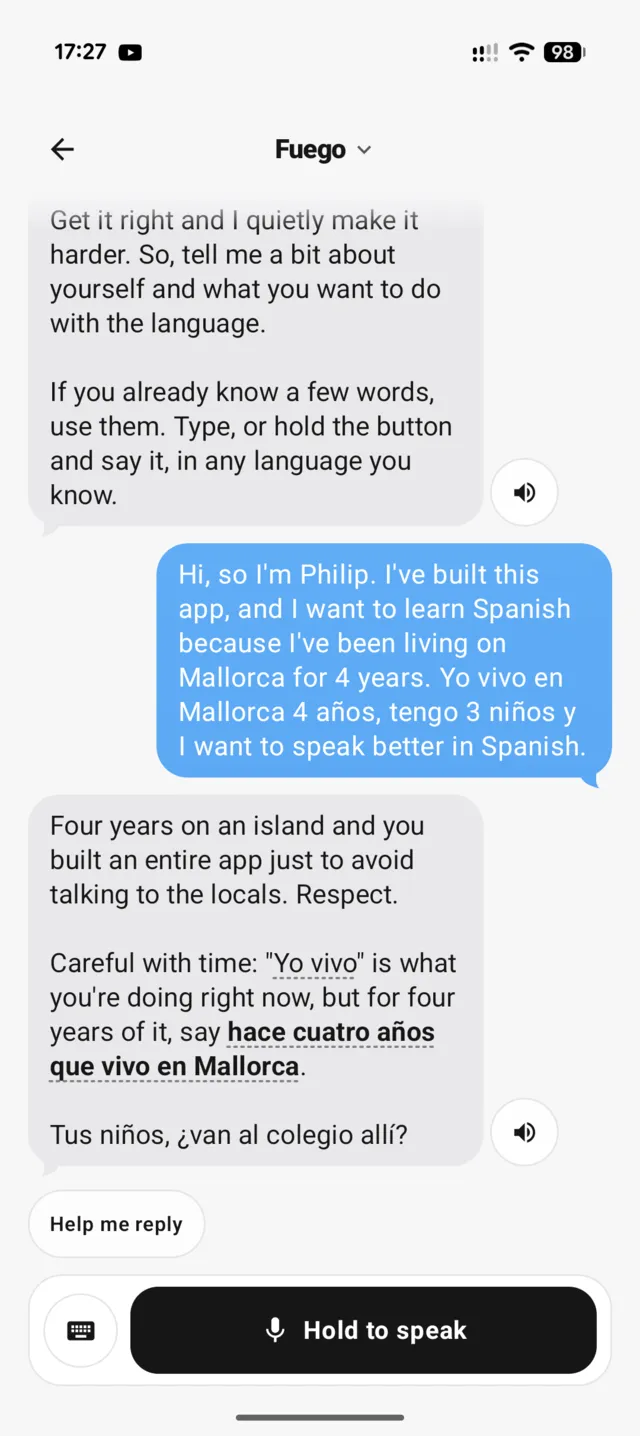
A 30-minute day could look like this: five minutes of new words with audio, fifteen minutes of conversation, five minutes going over the corrections, and five minutes of flashcard review. The conversation is the hard part to arrange. A teacher or a language exchange partner is the best option, but booking one every day is expensive or hard to schedule.
That gap is why we built Fuego, an AI tutor you talk to in Spanish by voice or by text. You hold a button and speak, or you type, and the tutor answers, keeps the conversation going and corrects your mistakes with a short reason. It adapts to your level as you talk. Fuego's tutor speaks the Spanish of Spain. After each conversation, the words you struggled with shape your next flashcards, and your mistakes come back as a quick fix, so the review part of the routine happens on its own. Fuego is a subscription app: your first conversation with the tutor is free, and words, flashcards, reading, listening and the daily plan stay free.
For the words step, our 1,000 common Spanish words list is free in your browser: each word has a meaning, an example sentence, audio and a picture, and a test mode hides the meanings so you can check yourself.
Can you speed it up?
Yes, within limits. The surest way to cut months off is to add hours. Beyond that, a few habits help without adding time:
- Spend part of every session on output. Say or write something new each day, even if it is three sentences about your morning.
- Review on a schedule. Flashcards with spaced repetition bring a word back right before you would forget it, which wastes less time than rereading lists.
- Learn the words you will actually use. Start with common, everyday words and phrases for your own life. A word list sorted into themes (food, travel, work) makes this easy.
Cramming helps less than it feels like it does. Words you rush through in one week fade in the next unless you review them, which is why the daily habit matters more than the occasional big session.

Frequently asked questions
How long does it take to become fluent in Spanish?
It depends on what you call fluent. If fluent means talking with native speakers on most everyday topics without freezing, that is about B2, roughly 500 to 600 hours of guided study, or about three years at 30 minutes a day. The FSI's professional level takes its full-time students 30 weeks and about 1,200 hours of class and homework. Native-like Spanish (C2) is closer to 1,000 to 1,200 guided hours.
Can you learn Spanish in 3 months?
You can reach a useful A1, or the start of A2, in three months at about an hour a day. That is enough to handle a trip, introduce yourself and follow slow, simple speech. Conversational fluency in three months is not realistic for most people unless they study full time, and even FSI students, who do, take about seven months to reach a professional level.
How many hours a day should I study Spanish?
Pick an amount you can keep up every day, then protect it. Thirty minutes a day reaches A2 in about a year and B1 in about two. An hour a day halves that. Consistency matters more than size, because a gap of a week or two costs you review time when you come back.
Is Spanish hard to learn for English speakers?
It is one of the easier languages for English speakers. The FSI places Spanish in Category I, its group of languages closest to English, at 30 weeks of full-time study. The verb system and the two past tenses take most learners a while, and native speech can sound very fast at first. Pronunciation is fairly regular, though: most words sound the way they are written.
How long does it take to learn Spanish with Duolingo?
In Duolingo's own 2024 study, learners took about 200 hours, over roughly nine months on average, to finish the beginner content it aligns to A2. They read at about a B1 level by then, but their speaking was rated near A1. Duolingo ran and published that study itself. Our guide Does Duolingo work? looks at all the research.
How do I find out my current Spanish level?
Take a level test. Our free Spanish level test checks words, listening and grammar in about 8 minutes and gives you a likely CEFR level, as an estimate rather than a certificate. Then find your row in the hours table above and count forward. Official exams such as the DELE give a certified level if you need one for work or study.
Does speaking practice make learning faster?
It makes speaking faster, which is what most people mean by "learning Spanish". Learners who only read and tap through exercises tend to understand far more than they can say, as the Duolingo study above showed. Fifteen minutes of conversation a day, with a person or an AI tutor, puts your hours into the skill you actually want to use.
Sources checked October 6, 2026
- US Department of State, Foreign Service Institute: Foreign language training (Spanish 30 weeks, Category I 552 to 690 class hours, ILR 3 in speaking and listening, 23 class plus 17 self-study hours a week, the variability caveat)
- Interagency Language Roundtable: Skill level descriptions, speaking (level 3, General Professional Proficiency)
- Cambridge English: Guided learning hours (cumulative hours per CEFR level, "a guideline only")
- ACTFL: Assigning CEFR ratings to ACTFL assessments (receptive Intermediate High = B1.1, productive Novice High = A1)
- Diplomatic Language Services: ILR vs. ACTFL vs. CEFR (ILR 3 near C1, "an approximation rather than an official conversion", July 2026)
- Duolingo Research Report DRR-24-04, Jiang, Hopman, Reuveni and Kittredge: Duolingo Path Meets Expectations for Proficiency Outcomes (April 2024; written and published by Duolingo; 165 Spanish learners, about 200 hours and about nine months to the end of A2 content, speaking Novice High)
- Duolingo blog, Cindy Blanco: How long does it take to learn Spanish, French and other languages? (May 2023)
- Fuego: the app as it stood on October 6, 2026
Related guides
- Spanish level test
- 1,000 common Spanish words
- Learn Spanish with Fuego
- Best Duolingo Alternatives in 2026: 8 Apps Compared
- Babbel vs Duolingo (2026): Which Language App to Pick
- Speak with an AI Language Tutor: 7 Apps Compared (2026)
- Learn Spanish with AI: 6 Apps and a Daily Routine (2026)
- Does Duolingo Work? What the Research Says (2026)
- Spanish Conversation Examples: 12 Dialogues, A1 to B2
- Spanish Conversation Practice: 6 Methods and a Weekly Plan
- How to Practice Speaking a Language Without a Partner
- Fuego vs Praktika: Daily Review or Avatar Tutors?
- Fuego vs Speak: A Daily Plan or a Spoken Course?
- Fuego vs Langua: Daily Activities or Flexible Calls?
- Fuego vs Talkpal: Daily Review or More Language Choice?
- Fuego vs Pingo AI: Conversation and What Comes After
- Praktika Alternatives: Choose by Your Learning Goal
- Duolingo Max Alternatives for Conversation Practice
- Best App to Learn Polish: Choose by Your Study Goal