Does Duolingo Work? What the Research Says (2026)
Yes, Duolingo works for vocabulary, reading and a daily habit, but on its own it does much less for speaking. In Duolingo's own 2024 study, Spanish learners who finished its beginner course read at about a B1 level yet spoke at about A1, after roughly 200 hours. Keep it as your base and add real conversation.
- Most of the large studies were run or paid for by Duolingo. The research table below says who ran each one.
- What to do: keep the streak as your base, and add 10 to 15 minutes of real conversation a day, with a person or an AI tutor.
That answer comes from reading the studies rather than the app store reviews. There are more of them than most people expect, and most were run or paid for by Duolingo, which we flag in every case. Taken together, they agree on more than either the fans or the critics usually admit.
What does Duolingo train, and what does it leave out?
Ratings are our summary of the studies listed further down, checked October 6, 2026.
| Skill | How Duolingo trains it | Evidence | What to add |
|---|---|---|---|
| Daily habit | Streaks, short lessons, reminders | Not measured; its design focus | Nothing, keep it |
| Vocabulary | Repeated short exercises, review lessons | Good for recognizing words | A themed word list with audio |
| Reading | Sentences, then short stories | Strongest measured skill | Real texts once you pass A2 |
| Listening | Audio exercises, stories | Good, behind reading | Podcasts and series at natural speed |
| Grammar | Patterns in exercises, Explain My Answer | Learned by example | A grammar reference when stuck |
| Writing | Typed translations and answers | Moderate | Short daily journal |
| Speaking in conversation | Speaking exercises; Video Call on Max | Weakest measured skill | Daily conversation with a person or AI tutor |
The pattern is consistent across the research: the more a skill depends on recognizing something, the better Duolingo does with it, and the more a skill depends on producing Spanish on the spot, the less it does.
What does the research say about Duolingo?
Here are the studies most often cited, oldest first, with who ran or paid for each. ACTFL levels are the US proficiency scale; ACTFL's own crosswalk puts Intermediate High reading at about B1 and Novice High speaking at about A1.
| Study | Who ran or paid for it | Learners | What it found | Limits |
|---|---|---|---|---|
| Vesselinov & Grego, 2012 | Commissioned by Duolingo, white paper | Spanish learners | Favorable learning outcomes | Not peer reviewed |
| Loewen et al., 2019, ReCALL | Academic researchers | 9 beginners of Turkish, one semester | Gains, and more time meant more gain | Nine learners, one language |
| Shortt et al., 2021, CALL | Independent review | 35 studies, 2012 to 2020 | Most research studied app design, not learning outcomes | Review, not a test |
| Jiang et al., 2021, Foreign Language Annals | Duolingo staff plus one university author; Duolingo paid for the tests | 225 US adults, Spanish or French | Reading and listening matched four university semesters | Speaking not tested |
| Jiang et al., 2021, report DRR-21-03 | Duolingo | 340 learners, first seven units | Reading and listening matched five semesters | Company report, speaking not tested |
| Smith, Jiang & Peters, 2024, Language Learning & Technology | Arizona State and Duolingo; funded by Duolingo | 48 Spanish learners, about 27 hours over 3 months | Significant gains in every skill tested, speaking included | Small group, 30% dropped out |
| Jiang et al., 2024, report DRR-24-04 | Duolingo | 165 Spanish and 92 French learners | After about 200 hours: Spanish reading Intermediate High, speaking Novice High | Company report |
Two things stand out. First, the evidence that Duolingo teaches something is solid: every study in the table that tested learners found gains or class-level results, including the independent one. Second, almost all of the large studies come from Duolingo itself. That does not make them wrong, and several were peer reviewed, but it is why the claims you see in Duolingo's marketing ("as effective as classroom learning", "five sections of Duolingo teaches as much as five semesters") deserve a closer look. Those comparisons are about reading and listening. The one large study that tested all four skills found speaking furthest behind.
The independent review by Shortt and colleagues makes a related point from the other side. Of the 35 Duolingo studies published from 2012 to early 2020, most looked at how the app is designed, and few measured what learners could actually do afterwards.
Why does speaking lag behind on Duolingo?
The studies show where the gap is more clearly than why. In the 2024 Duolingo report, Spanish learners who reached the end of the A2 content were rated Intermediate High in reading, Intermediate Mid in listening, Intermediate Low in writing and Novice High in speaking. The authors write that speaking was "approaching Intermediate Low", which is still the weakest of the four.
The learners themselves noticed. In the 2024 Language Learning & Technology study, participants liked the app but pointed to a lack of practical listening, speaking, pronunciation and conversational support. That same study measured some of its biggest gains in speaking and pronunciation, so the app is not doing nothing here. It just starts from zero and gets you to "can say short things", not "can hold a conversation".
Duolingo has tried to close the gap with Video Call, part of its top Max plan, where you talk with the character Lily about anything you like. Duolingo describes it as low pressure on purpose: Lily adjusts to your level, and she does not correct your grammar. That is a fine way to get used to talking, but it means the mistakes you make there are not pointed out.
What does Duolingo do well?
More than its critics usually say. The courses are free, and paying removes ads and adds extras rather than unlocking the course itself. The Spanish course for English speakers is aligned to the CEFR, the A1 to C2 scale schools and exams use, and it runs to the end of B2. Explain My Answer, the feature that tells you why an answer was wrong, used to need the paid Max plan and has been free for everyone since January 2026.
Its biggest strength is the one the studies cannot measure well: it gets people to come back. A course you open every day beats a better course you abandon in week two, and Duolingo is very good at the coming back. If you have a long streak, you already have the habit, and the open question is what to fill those minutes with.
Can you become fluent with Duolingo alone?
Not if fluent means speaking easily with native speakers. The course ends at B2, and the measured outcomes so far show learners understanding far more than they can say. For scale, the US Foreign Service Institute estimates that its full-time students need 30 weeks, or 690 class hours, to reach professional working Spanish, with a teacher and conversation in every lesson. Our guide How long does it take to learn Spanish? breaks those hours down by level and by minutes a day.
So Duolingo can carry you a long way toward understanding Spanish. What it cannot do, by its own data, is replace time spent talking.
Who should add what to Duolingo?
Match the add-on to the gap you feel.
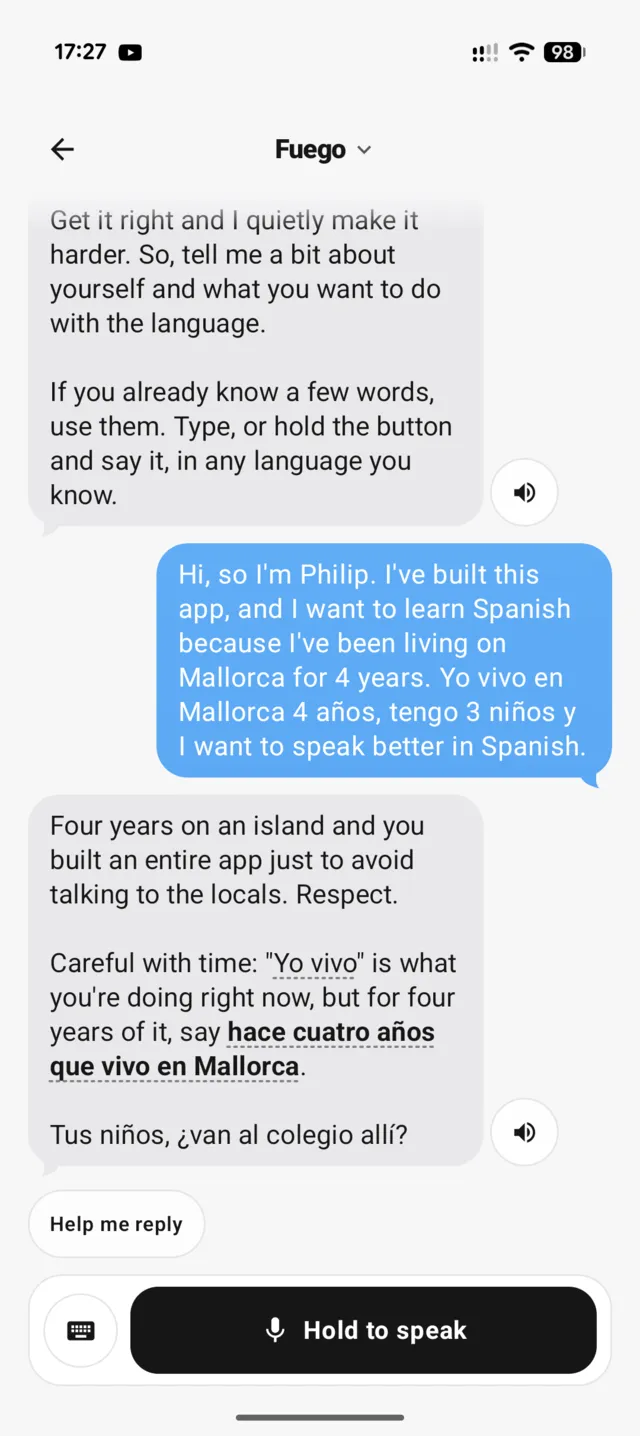
- You can read Spanish but freeze when someone talks to you. Add 10 to 15 minutes of conversation a day. A teacher or a language exchange partner is ideal if you can schedule one. An AI tutor is the easiest daily option. We make Fuego, an AI tutor you talk to by voice or by text: you hold a button and speak, or type, and it keeps the conversation going and corrects you with a short reason. After each conversation the words you struggled with shape your next flashcards. Fuego is a subscription app, and your first conversation with the tutor is free.
- You do not understand real Spanish at real speed. Add podcasts or a series you like, with Spanish subtitles. Course audio is made for learners, and real speech is faster and messier.
- You keep making the same grammar mistake. Use Explain My Answer when it appears, and keep a grammar reference for the two or three topics that keep biting you (for Spanish, usually ser and estar, and the two past tenses).
- You have a trip in three months. Keep the streak, and add a list of common words and phrases for the situations you will meet. Our 1,000 common Spanish words list is free in your browser, sorted into themes, with audio for every word.
- You need a certificate for work or study. Prepare for that exam specifically. Duolingo's course levels are not an official certificate.
- You are not sure where you stand. Take our free Spanish level test, which estimates your CEFR level in about 8 minutes, then decide which gap matters most.
How do you get more out of Duolingo?
Duolingo's own advice and its research point the same way. Its blog says a three-minute lesson keeps a streak alive but longer sessions are what build proficiency, and it asks learners to keep the sound on and not skip the speaking exercises. Its 2024 report adds a detail worth acting on: learners who answered more accurately in their sessions reached higher proficiency, while sheer hours and session counts did not predict a better result.
In practice that means three habits. Do at least one full session a day on top of the streak-saver. Say every speaking exercise out loud, even on a bus, quietly. And when lessons feel too easy, move forward instead of farming review lessons for points. Then, once a week, test yourself outside the app: try to describe your day in Spanish for two minutes without stopping. In the research so far, that is the skill that lags furthest behind.
Frequently asked questions
Is Duolingo effective for learning Spanish?
Yes, for the parts of Spanish it trains most. In Duolingo's own 2024 report, Spanish learners who finished the beginner content read at about B1 and understood spoken Spanish at about A2, after about 200 hours. Their speaking was rated near A1. An independent 2019 study of Duolingo found real gains too, and that more time on the app meant more learning.
Is Duolingo Max worth it for speaking practice?
It adds Video Call, an open voice conversation with the character Lily, plus Roleplay. That is more speaking than the free plan offers, and it is low pressure. The trade-off is that Lily does not correct your grammar, by design. If you want corrections on what you say, a teacher or an AI tutor that corrects you, such as Fuego, fills that gap. Check the store for Max's price in your country.
Does Duolingo teach grammar?
Mostly by example. You absorb patterns through repeated sentences rather than reading rules. Explain My Answer, now free for everyone, tells you why an answer was wrong. Many learners still keep a grammar reference for tricky topics, such as ser and estar or the two Spanish past tenses, because seeing the rule laid out once saves weeks of guessing.
How long should I use Duolingo each day?
Longer than the streak needs. Duolingo itself says a three-minute lesson keeps the streak alive, while longer sessions build proficiency. Fifteen to thirty minutes a day is a realistic range. In Duolingo's 2024 report, learners took about 200 hours over roughly nine months to finish the beginner content, which is a little over 40 minutes a day on average.
Is Duolingo as good as a university class?
For reading and listening, Duolingo's own studies found results similar to several semesters of university Spanish. Those studies did not test speaking, and a class gives you a teacher and classmates to talk to every week. If you can only do one, Duolingo is the cheaper and more flexible start; if you want to speak, the class gives you more of it.
Can Duolingo get you to B2?
The Spanish course for English speakers is aligned to the CEFR and runs to the end of B2. Finishing it is not the same as being B2 in every skill, though: in the measured results so far, learners' speaking trails their reading by about two CEFR levels. To be B2 in conversation, add regular speaking practice well before you reach the last sections.
Is it bad to keep a streak with one easy lesson?
Not on a busy day. The streak's job is to keep you coming back, and it does that well. The trouble starts when the easy lesson becomes the whole habit. Duolingo's own report found accuracy, not hours, linked to better results, so aim for a real session most days and save the quick lesson for the days that need it.
Sources checked October 6, 2026
- Duolingo Research Report DRR-24-04, Jiang, Hopman, Reuveni and Kittredge: Duolingo Path Meets Expectations for Proficiency Outcomes (April 2024; written and published by Duolingo)
- Duolingo Research Report DRR-21-03, Jiang et al.: Seven units of Duolingo courses comparable to 5 university semesters in reading and listening (November 2021; written and published by Duolingo)
- Jiang, Rollinson, Plonsky, Gustafson and Pajak, 2021: Evaluating the reading and listening outcomes of beginning-level Duolingo courses, Foreign Language Annals 54(4). ERIC record, full text hosted by Duolingo (four authors at Duolingo; "The tests, paid for by Duolingo"; also describes Vesselinov and Grego 2012 as commissioned and not peer reviewed)
- Smith, Jiang and Peters, 2024: The effectiveness of Duolingo in developing receptive and productive language knowledge and proficiency, Language Learning & Technology 28(1) ("This study was supported financially by Duolingo")
- Loewen, Crowther, Isbell, Kim, Maloney, Miller and Rawal, 2019: Mobile-assisted language learning: A Duolingo case study, ReCALL 31(3)
- Shortt, Tilak, Kuznetcova, Martens and Akinkuolie, 2021: Gamification in mobile-assisted language learning: a systematic review of Duolingo literature from public release of 2012 to early 2020, Computer Assisted Language Learning
- ACTFL: Assigning CEFR ratings to ACTFL assessments
- Duolingo blog: Does Duolingo work? (November 2024), Video Call (September 2024), Is Duolingo free? (September 2024), Explain My Answer is now free (January 2026), How long does it take to learn Spanish, French and other languages? (May 2023, course sections to B2)
- US Department of State, Foreign Service Institute: Foreign language training
- Fuego: the app as it stood on October 6, 2026
Related guides
- Spanish level test
- 1,000 common Spanish words
- Learn Spanish with Fuego
- Best Duolingo Alternatives in 2026: 8 Apps Compared
- Babbel vs Duolingo (2026): Which Language App to Pick
- Speak with an AI Language Tutor: 7 Apps Compared (2026)
- Learn Spanish with AI: 6 Apps and a Daily Routine (2026)
- How Long Does It Take to Learn Spanish? Hours by Level
- Spanish Conversation Examples: 12 Dialogues, A1 to B2
- Spanish Conversation Practice: 6 Methods and a Weekly Plan
- How to Practice Speaking a Language Without a Partner
- Fuego vs Praktika: Daily Review or Avatar Tutors?
- Fuego vs Speak: A Daily Plan or a Spoken Course?
- Fuego vs Langua: Daily Activities or Flexible Calls?
- Fuego vs Talkpal: Daily Review or More Language Choice?
- Fuego vs Pingo AI: Conversation and What Comes After
- Praktika Alternatives: Choose by Your Learning Goal
- Duolingo Max Alternatives for Conversation Practice
- Best App to Learn Polish: Choose by Your Study Goal